Whole Egg Types & Commercial Formats
Whole Egg Formats, Species & Kitchen Conversions
Shell, liquid, powder, and in-shell pasteurized whole eggs — plus duck and quail species swaps and basic cookery notes. For recipe scaling and food diary logging. Informational only.
Fresh Shell Whole Eggs (Grade AA / A)
Commercial format
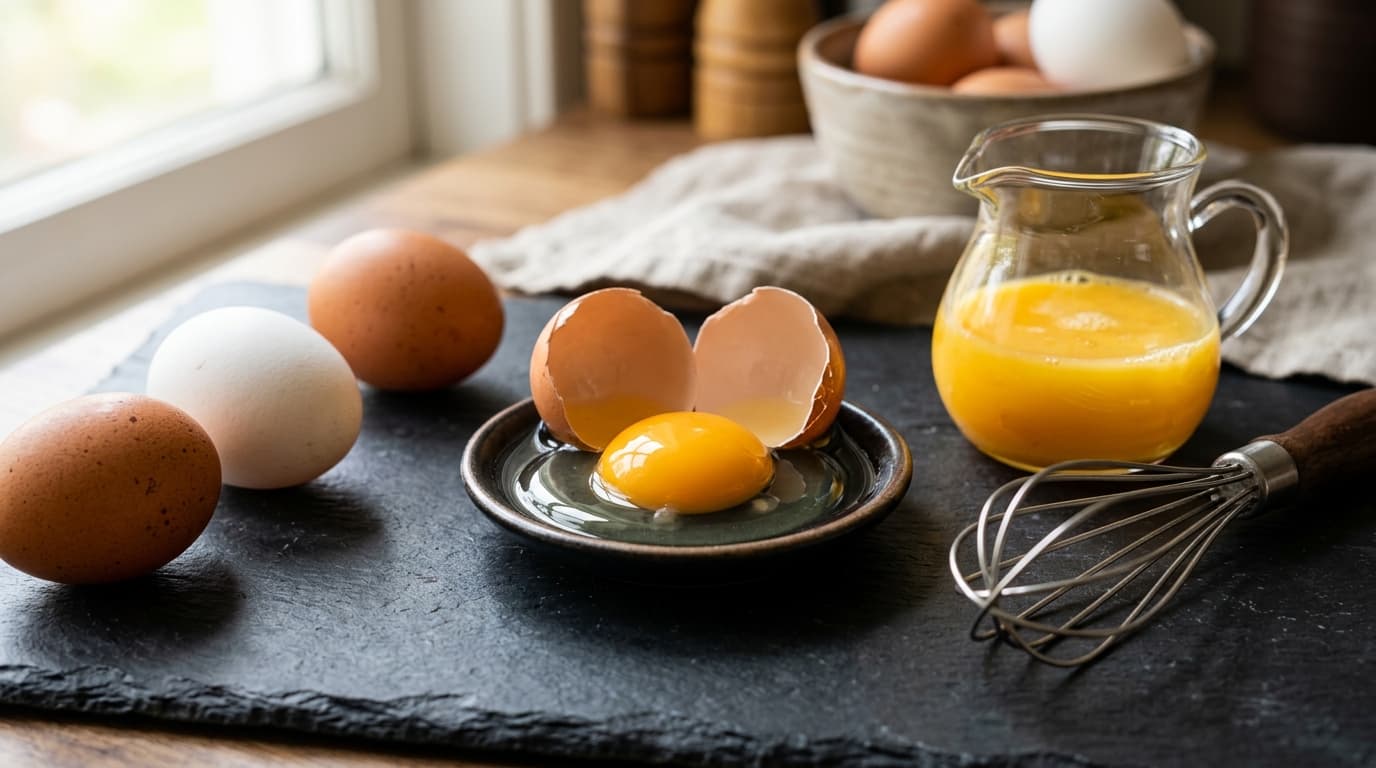
Unbroken whole eggs in their natural shell — the default for table cookery and most home recipes. A Large egg yields ~50g edible mass (~33g white + ~17g yolk). Log at FDC 171287 unless you weigh a different size.
Grading & Composition
- USDA 7 CFR Part 56 defines Grade AA (firm albumen, high yolk) and Grade A (standard retail).
- Shell cuticle (bloom) helps limit moisture exchange through thousands of microscopic pores.
- Albumen pH rises from ~7.6 at lay toward ~9.2 during refrigerated storage as CO₂ escapes.
- FDC 171287: 50g edible = 72 kcal, 6.3g protein, 4.8g fat.
Kitchen Uses
- Best when yolk integrity matters: poached, sunny-side up, soft-boiled.
- Manual separation for meringue (white) or enriched custards (yolk).
- Store in original carton on an interior refrigerator shelf.

Refrigerated Pasteurized Liquid Whole Eggs
Commercial format
Machine-cracked eggs blended to natural yolk/white ratio, pasteurized under USDA FSIS rules (9 CFR 590). Skips manual cracking — common in commercial kitchens for scrambles, quiches, and batters.
Processing Specs
- Continuous pasteurization (~140°F / 60°C) without coagulating proteins.
- May include ~0.15% citric acid to reduce gray-green discoloration during steam-table warming.
- Packaged in 2 lb cartons, bag-in-box, or bulk totes for automated dispensing.
Kitchen Uses
- High-volume scrambles, quiches, and commercial cake batters.
- 50g (3.25 tbsp) substitutes 1 Large shell egg in baking formulas.
- Refrigerate opened cartons; use within 3–5 days.

Spray-Dried Whole Egg Solids (Powder)
Commercial format
Liquid whole egg atomized and flash-dried to below 5% moisture. Stores at room temperature and reconstitutes to match fresh whole egg macros when mixed at the AEB 1:3 ratio.
Dehydration Specs
- Flash drying preserves protein solubility for reconstitution.
- Glucose-free (desugared) grades reduce Maillard darkening during long storage.
- 1 lb powder reconstitutes to ~36 Large eggs — ~75% less volume than shell.
Kitchen Uses
- Reconstitution: 12.5g powder + 37.5g water = 1 Large egg.
- Common in dry cake mixes, pancake batters, and camping kits.
- Blend powder with dry flour first, then add water to wet ingredients to avoid clumps.
In-Shell Pasteurized Whole Eggs
Commercial format
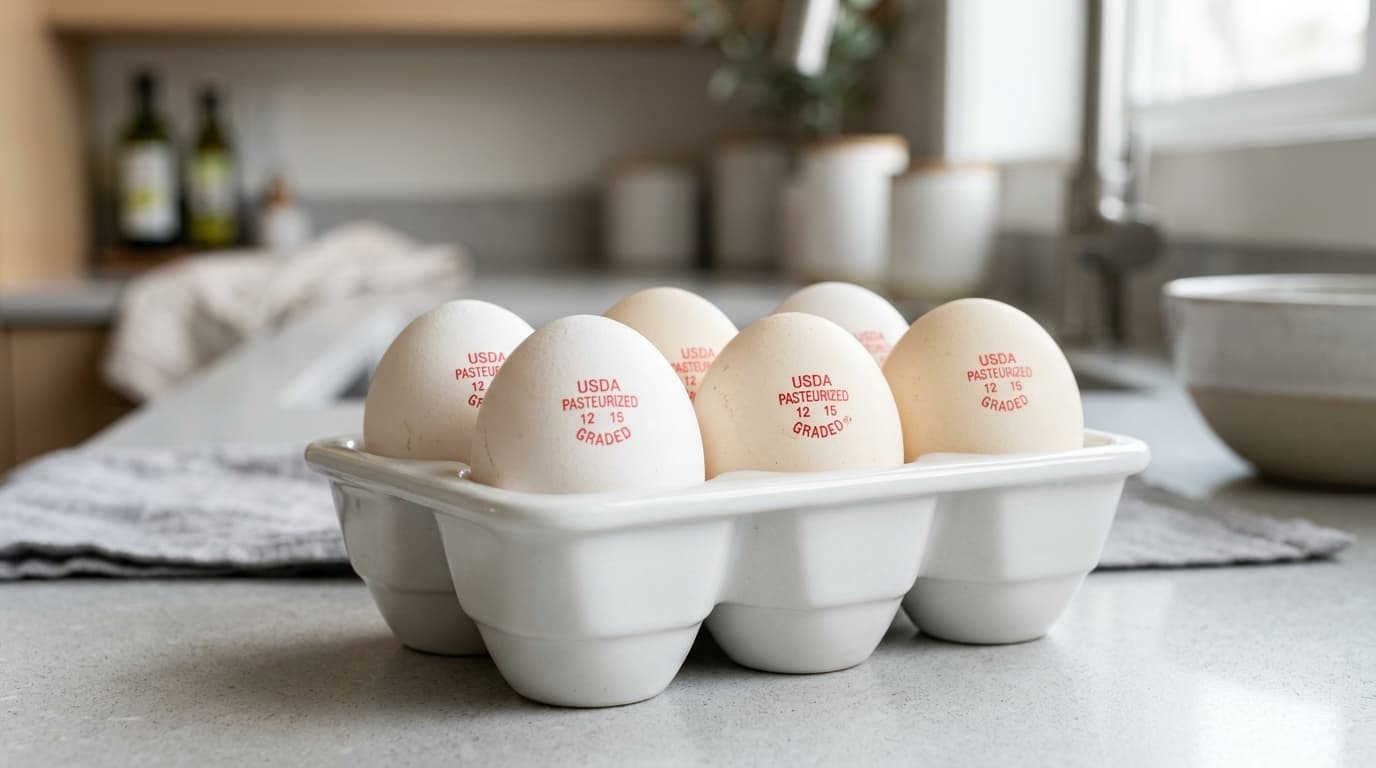
Shell eggs warm-water treated so yolk and white stay fluid. The red “P” stamp marks in-shell pasteurization — used when recipes call for raw or lightly cooked whole egg and you choose pasteurized eggs in your kitchen.
Pasteurization Process
- Heated below ovalbumin denaturation (~145°F) to keep whites and yolks liquid.
- Shell stamped with food-safe ink; some brands add a thin mineral-oil seal.
- Albumen may appear slightly cloudier than untreated eggs; whipping volume is largely unchanged.
Kitchen Uses
- Caesar dressing, aioli, hollandaise, and eggnog when using pasteurized in-shell eggs.
- 1:1 drop-in for any shell-egg recipe by count or weight.
- Refrigerate and use by the carton date.
Duck Whole Eggs
Avian species
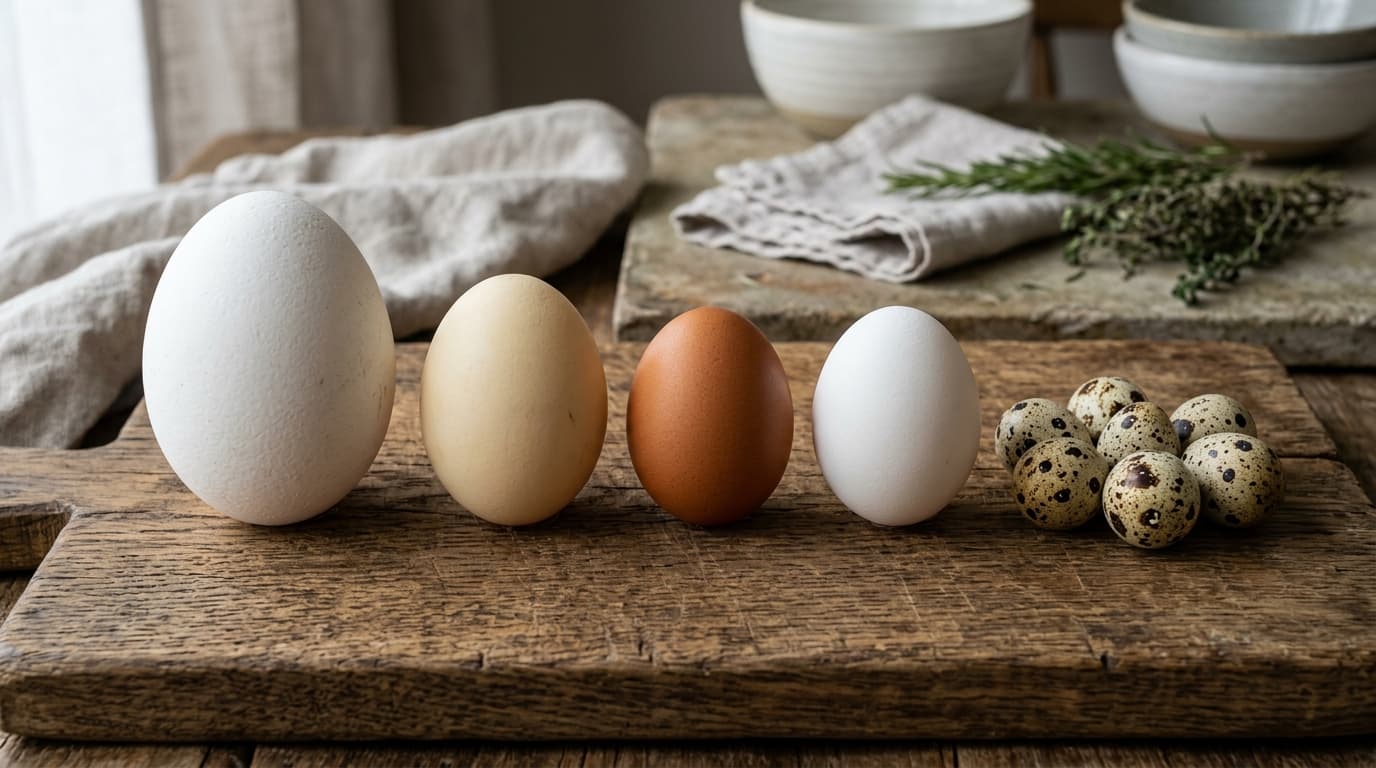
Larger and richer than chicken eggs — thick shell, dense albumen, deep golden yolk. Log at FDC 01138. Substitute by **grams**, not shell count: one duck egg (~70g) ≈ 1.4 Large chicken eggs (50g).
Composition Notes
- Albumen has slightly lower water content and higher ovalbumin than chicken.
- Higher yolk fat delivers richer mouthfeel in custards and enriched doughs.
- Thicker shell cuticle suited to damp nesting environments.
Kitchen Uses
- Popular in sponge cakes, brioche, and handmade pasta for loft and color.
- Weigh cracked liquid — do not swap 1 duck for 1 chicken by count.
- Use gentler heat when pan-frying; albumen sets firmly.
Quail Whole Eggs
Avian species
Small speckled eggs with the highest yolk-to-white ratio among common commercial species (~39% yolk). Log at FDC 01140. **5–6 quail eggs ≈ 1 Large chicken egg** (~50g liquid).
Composition Notes
- Speckling comes from protoporphyrin and biliverdin pigments in the oviduct.
- Tough inner membrane — quail egg scissors help clean opening.
- Rich yolk flavor per gram of edible mass.
Kitchen Uses
- Garnishes for canapés, yakitori, and small-plate presentations.
- Soft-boil ~2 min 15 sec for a jammy center; hard-boil ~3 min.
- Pickle whole or tempura-fry for charcuterie boards.

Whole Egg Cookery & Emulsion Basics
Cookery reference
Albumen and yolk set at different temperatures and play different roles: albumen provides structure; yolk lecithin stabilizes emulsions and adds richness. Together they define texture in omelets, custards, and baked goods.
Thermal Behavior
- Dilution with milk or cream (quiches, custards) raises coagulation toward 175°F–180°F.
- Yolk phospholipids form the boundary layer in mayonnaise and hollandaise.
- Overheating contracts the protein gel and squeezes out liquid (syneresis).
Kitchen Uses
- French omelet: gentle heat, constant motion, no browning.
- Strain custard bases through a fine sieve to remove chalazae.
- Egg wash (1 egg + 1 tbsp water) for glossy baked crusts.
- Temper eggs with hot liquid before combining to avoid curdling.
Whole Egg Conversion & Format Calculator
Convert between shell eggs, pasteurized liquid, and dried powder by gram weight. Swap avian species, compare whole vs white vs yolk nutrients, and scale batch recipes. Informational only — not dietary advice.
Mix 37.5g powder with 112.5 mL cool water. To avoid clumping, blend the powder with the recipe’s dry flour or sugar first, then whisk in water smoothly.
At a Glance
Whole egg = unseparated albumen and yolk. USDA Large baseline: 50g edible, 72 kcal, 6.3g protein, 4.8g fat (FDC 171287).
Formats: Fresh shell (retail), pasteurized liquid (foodservice), frozen pails, spray-dried powder (1:3 reconstitution), in-shell pasteurized (red “P”), and pre-cooked peeled hard-boiled.
Species: Duck (~70g), quail (~9g), goose (~144g), turkey (~79g) — substitute by liquid grams, not shell count.
Logging tip: Whole egg, white-only, and yolk-only entries use FDC 171287, 172183, and 172184 respectively.
Reference Serving
Fresh shell for table cookery; liquid or powder for volume baking and batch prep.
Measure 50g liquid per Large egg when converting shell ↔ liquid ↔ powder. Pasteurized liquid: 3.25 tbsp (50g) per Large egg. Dried powder: 12.5g powder + 37.5g water = 1 Large egg (AEB 1:3 ratio).
Substitute duck or quail by weight, not count. Refrigerate perishable formats at ≤40°F (4°C). Informational only — not dietary advice.
Whole Egg Formats Compared (USDA / AEB Standards)
| Nutrient | Format | Composition | Solids | Shelf life | Storage | Typical use |
|---|---|---|---|---|---|---|
| Fresh shell whole eggs | Grade AA/A/B (7 CFR 56) | 24.2% | 3–5 weeks refrigerated | ≤45°F (7°C) | Poaching, frying, table eggs | |
| Refrigerated liquid whole | Pasteurized blend (9 CFR 590) | 24.2% min | 12–16 wks sealed | ≤40°F (4°C) | Scrambles, quiches, commercial batters | |
| Frozen whole eggs | Pasteurized, blast-frozen | 24.2% min | 1–2 years frozen | 0°F (-18°C) | Bulk bakery, pasta production | |
| Spray-dried whole powder | Dehydrated whole egg | 95% min | 1–2 years dry | Cool, dry pantry | Dry mixes, camping, long storage | |
| In-shell pasteurized | Red “P” stamp, warm-water treated | 24.2% | 6–8 weeks | ≤45°F (7°C) | Raw-style dressings, mayo, hollandaise | |
| Pre-cooked hard-boiled | Peeled, MAP-packaged | 24.2% | 45–60 days sealed | ≤40°F (4°C) | Salad bars, meal prep, deli |
Liquid/frozen/dried products are pasteurized under 9 CFR Part 590. Solids minimum 24.2% for single-strength whole egg.
Whole Egg Species Comparison (Per Typical Egg)
| Nutrient | Species | Edible (g) | Calories | Protein | Fat | Kitchen note |
|---|---|---|---|---|---|---|
| Chicken (Large) | 50 | 72 kcal | 6.3g | 4.8g | Recipe baseline — FDC 171287 | |
| Duck | 70 | 130 kcal | 9.0g | 9.6g | Richer yolk; weigh grams — FDC 01138 | |
| Quail | 9 | 14 kcal | 1.2g | 1.0g | 5–6 quail ≈ 1 Large — FDC 01140 | |
| Goose | 144 | 266 kcal | 20.0g | 19.1g | 1 goose ≈ 3 Large by weight | |
| Turkey | 79 | 135 kcal | 10.8g | 9.4g | 2 turkey ≈ 3 Large by weight |
USDA FDC baseline entries. Substitute in baking by total liquid grams, not shell count.
Whole vs White vs Yolk (per 100g edible, FDC)
| Nutrient | Nutrient | Whole (171287) | White (172183) | Yolk (172184) | Logging note |
|---|---|---|---|---|---|
| Calories | 143 kcal | 52 kcal | 322 kcal | Yolk holds ~78% of kcal per Large egg | |
| Protein | 12.6g | 10.9g | 15.9g | White contributes more total grams; yolk denser per gram | |
| Fat | 9.5g | 0.17g | 26.5g | ~99% of fat is in the yolk | |
| Cholesterol | 372 mg | 0 mg | 1,085 mg | Log with yolk-only entries | |
| Choline | 294 mg | 1.1 mg | 682 mg | Most choline is yolk-bound | |
| Vitamin D | 2.0 mcg | 0 mcg | 5.4 mcg | Fat-soluble; yolk only |
Per Large egg (~50g whole): divide 100g values by 2 for approximate logging.
Shell → Liquid → Powder Conversion (AEB)
| Nutrient | Large eggs | Liquid weight | Liquid volume | Dry powder | Water to reconstitute |
|---|---|---|---|---|---|
| 1 | 50g | 3.25 tbsp (48 mL) | 12.5g | 37.5 mL | |
| 2 | 100g | 6.5 tbsp (96 mL) | 25g | 75 mL | |
| 4 | 200g | ~3/4 cup (192 mL) | 50g | 150 mL | |
| 12 (1 dozen) | 600g | 2.4 cups (576 mL) | 150g | 450 mL |
1 part dried whole egg solids + 3 parts water by weight = reconstituted liquid whole egg.
What Counts as a Whole Egg
In recipes and food databases, a whole egg is the combined albumen and yolk — not separated. USDA Large baseline: 50g edible (~33g white + ~17g yolk), 72 kcal, 6.3g protein (FDC 171287).
Use the visual guide and converter below to swap between shell eggs, pasteurized liquid cartons, and dried powder while keeping the same gram total for logging.
Commercial Formats: Liquid, Frozen & Dried
Liquid whole egg is machine-cracked, blended to natural yolk/white ratio (≥24.2% solids), and pasteurized under USDA FSIS rules (9 CFR 590). Typical swap: 50g or 3.25 tbsp per Large shell egg.
Spray-dried powder stores at room temperature. Reconstitute with the AEB ratio: 1 part powder + 3 parts water by weight (12.5g powder + 37.5g water = 1 Large egg).
Frozen whole egg is pasteurized liquid blast-frozen for bulk foodservice. Thaw refrigerated 24–48 hours; do not thaw at room temperature.
In-Shell Pasteurized Whole Eggs (Red “P”)
These shell eggs are warm-water treated so yolk and white stay fluid. The red “P” stamp indicates in-shell pasteurization — common for recipes that call for raw or lightly cooked egg (Caesar dressing, mayonnaise, hollandaise, eggnog) when your workflow uses pasteurized eggs.
Treat like other refrigerated eggs: store at ≤40°F (4°C) and use by the carton date.
Species Whole Eggs: Duck, Quail & Goose
Duck (~70g): higher fat and albumen density — substitute by grams, not count. Quail (~9g): 5–6 eggs ≈ 1 Large chicken egg. Goose (~144g): one goose ≈ three Large eggs by liquid weight.
Macros scale with edible grams using the matching FDC entry when logging in your food diary.
Common Misconceptions
Myth: Liquid whole eggs are dyed yellow artificial product.
Fact: Liquid whole eggs are real eggs — cracked, blended, and pasteurized. Color comes from natural yolk carotenoids. Artificial coloring is prohibited in whole egg products under federal rules.
Myth: Dried egg powder loses all nutrition.
Fact: Spray-drying is rapid enough that amino acid profiles remain largely intact. Reconstituted powder matches fresh whole egg macros for logging when prepared at the correct 1:3 ratio.
Myth: Duck eggs swap 1:1 with chicken eggs by count.
Fact: One duck egg ≈ 70g vs 50g Large chicken — about 40% more liquid. Always substitute by measured grams in baking.
Myth: Pasture-raised whole eggs have double the protein.
Fact: Protein per Large egg stays ~6.3g when feed matches (FDC baseline). Labels mainly describe hen housing; yolk color and some micronutrients may vary by farm.
Myth: You can freeze eggs in the shell.
Fact: Water expands when frozen and will crack the shell. Whisk whole eggs without whipping in air, then freeze in a sealed container.
Practical Notes for Tracking
- •Log whole eggs at 50g edible (FDC 171287) unless you weigh a different size.
- •Use 50g liquid or 12.5g powder + 37.5g water per Large egg in recipes.
- •Substitute duck, quail, or goose by total liquid grams — not shell count.
- •Refrigerate shell, liquid, and opened cartons at ≤40°F (4°C).
- •Use in-shell pasteurized (red “P”) when your raw-recipe workflow calls for them.
Informational only — for personal nutrition awareness and journaling. Not personalized dietary advice. Disclaimer
Frequently Asked Questions
Scientific References & Data Sources
Nutrition values on this page are derived from the peer-reviewed sources below. This page is for informational food logging and personal awareness only. See our disclaimer.
Industry definitions for liquid, frozen, and dried whole egg products, solids percentages, and handling standards.
Shell-to-liquid and dried whole egg reconstitution reference for foodservice and home kitchens.
Federal regulations for pasteurized liquid, frozen, and dried egg products under continuous inspection.
Federal standards for shell egg grades (AA, A, B) and weight classes from Peewee to Jumbo.
Federal guidance on shell egg refrigeration, cooking until firm, and consumer handling.
Test-kitchen overview of how whole eggs, whites, and yolks function in sponge, foam, and butter cakes.
Baseline nutrient profile for Large raw whole chicken eggs (50g edible portion).
Nutrient profile for whole duck eggs (~70g edible portion).
Nutrient profile for whole quail eggs (~9g edible portion).
Our data sourcing, verification, and fact-checking methodology.