How to Freeze Eggs: Portion Chart & Freezer Batch Calculator
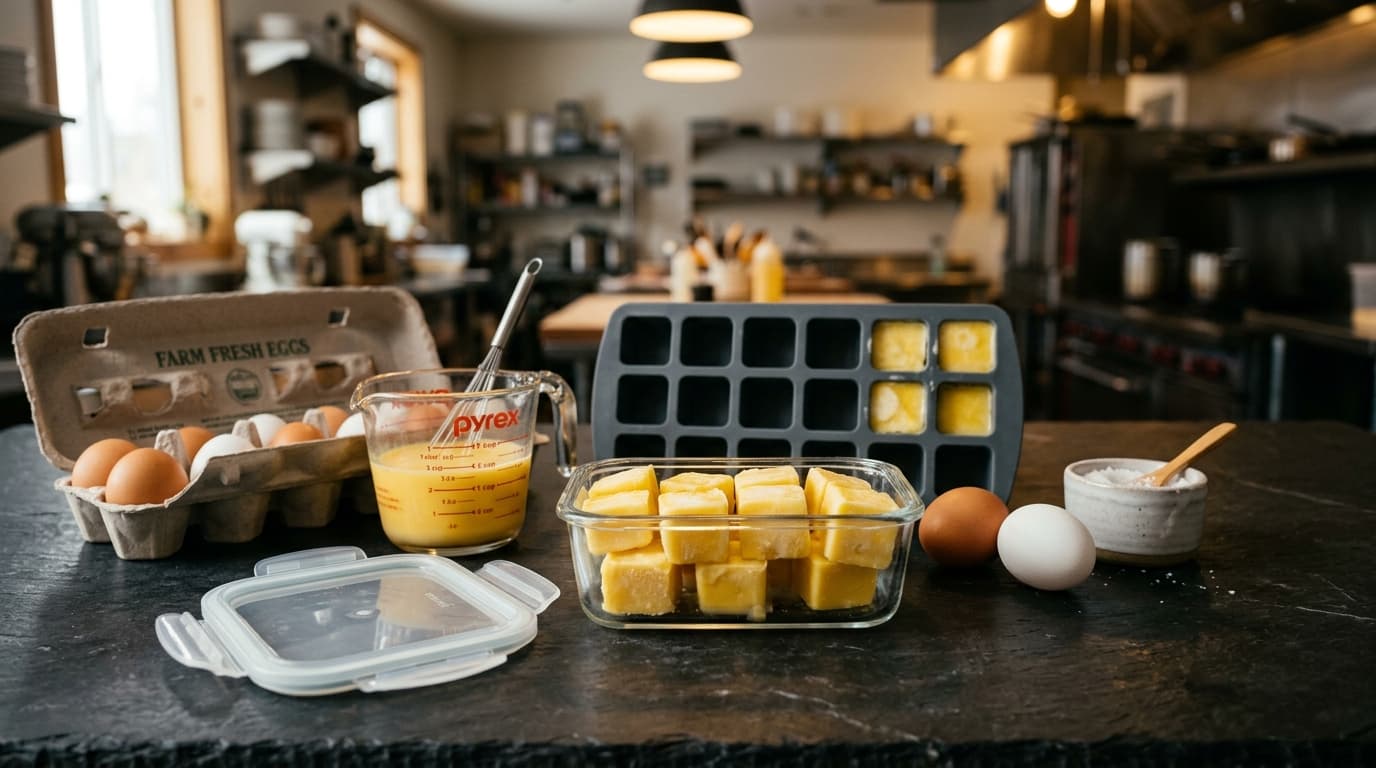
Never in-shell · 12 months at 0°F · 3 Tbsp whole = 1 Large egg
½ tsp salt OR 1½ tbsp sugar per cup (~5 Large)
Whites plain · yolks: ⅛ tsp salt OR 1½ tsp sugar / 4 yolks
Refrigerator overnight · use in fully cooked dishes
Can You Freeze Eggs? Yes — Out of Shell Only
Raw eggs freeze for up to one year with minimal quality loss — provided they are removed from shells first. Label containers with date, count, format, and any salt or sugar added.
AEB & USDA FSIS Standards
- •Freeze only clean, fresh eggs removed from their shells.
- •Peak quality maintained for 12 months at 0°F (-18°C).
- •Never freeze raw eggs in-shell — water expansion cracks the shell.
- •Use thawed eggs in fully cooked dishes (scrambles, baking, casseroles).
Meal Prep Tips
- •Freeze seasonal surpluses during peak laying months.
- •Use silicone trays for single-egg portions, then bag the cubes.
- •Always label: date, format (whole/white/yolk), count, salt or sugar added.
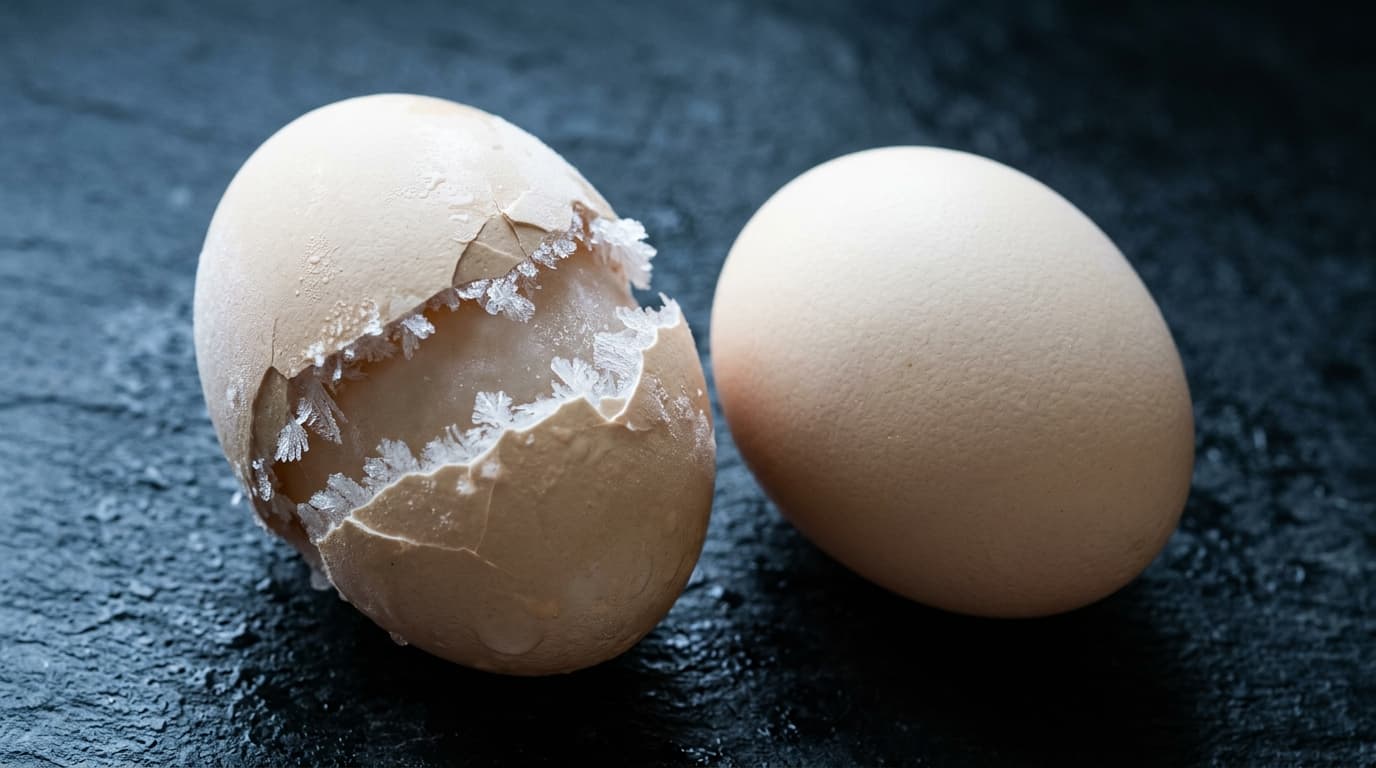
Why In-Shell Freezing Fails: 9% Water Expansion
Liquid egg content is ~75% water. Ice crystallization expands ~9%, fracturing the brittle shell. If an egg accidentally freezes in the fridge with a cracked shell, discard it. If the shell stays intact, keep frozen and thaw in the refrigerator.
Accidental Refrigerator Freezing
- •Ice requires more volume than liquid water, generating internal pressure on the shell.
- •Cracked shell → discard the egg.
- •Intact shell → keep frozen until use, thaw in fridge, use in fully cooked dishes.
- •Thawed yolk will be thicker than usual (gelation) but usable in baked casseroles.
Fridge Placement
- •Keep refrigerator at 35°F–38°F (2°C–3°C).
- •Avoid storing eggs against rear cooling coils where freeze spots occur.
- •Check cartons for hairline frost fractures before use.
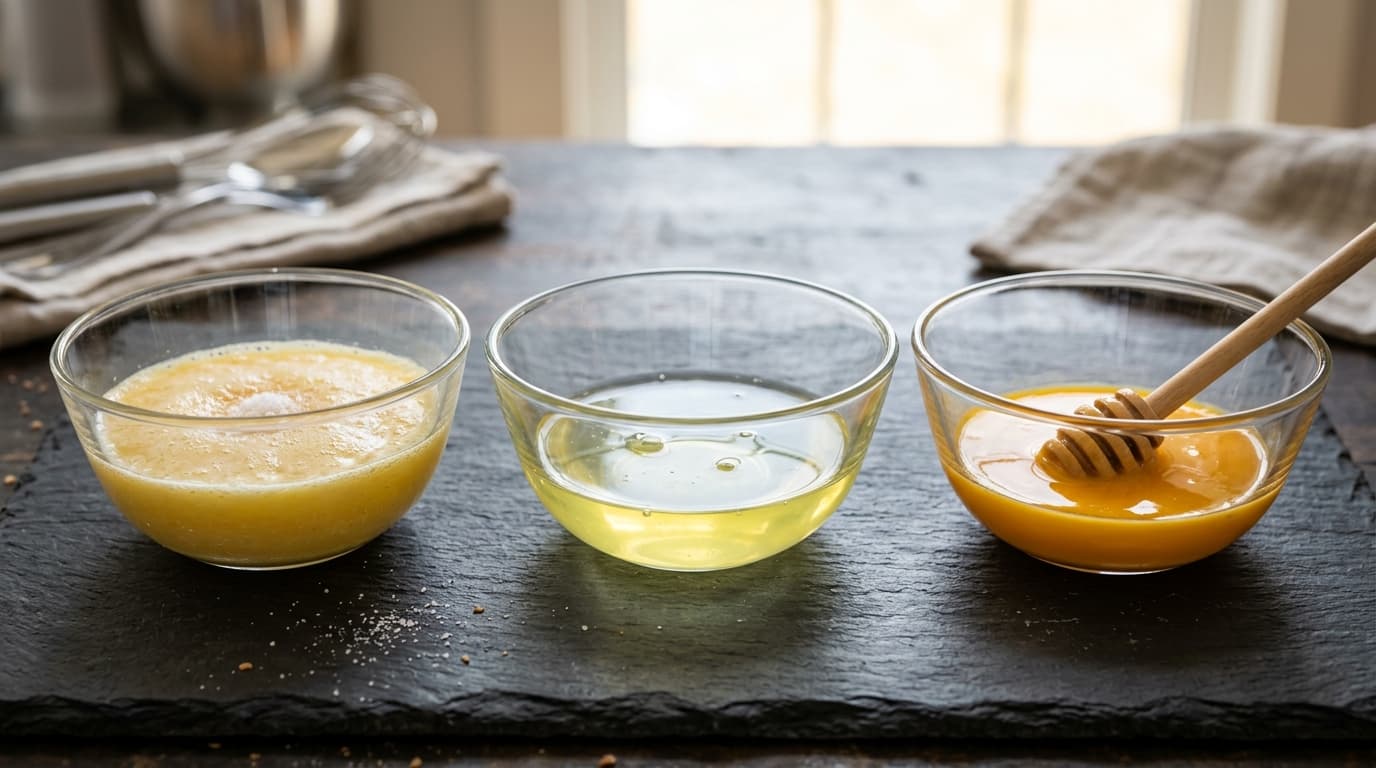
Three Formats: Whole, Whites & Cryoprotected Yolks
Whole eggs need gentle blending plus salt or sugar to keep yolks smooth. Whites freeze plain. Separated yolks require cryoprotectant salt (savory) or sugar (sweet) to prevent rubbery gelation.
Preparation Steps (NCHFP & AEB)
- •Whole: whisk gently without incorporating air; add salt or sugar per cup (~5 Large).
- •Whites: pour plain separated whites — no additives needed.
- •Yolks: beat in salt or sugar before freezing to prevent gelation.
- •Strain through a sieve for uniform texture (optional NCHFP step).
Savory vs Sweet Selection
- •Salted batches → scrambles, frittatas, omelets, savory doughs.
- •Sugared batches → cakes, waffles, pancakes, custards, ice cream bases.
- •Deduct added salt or sugar from your final recipe totals.
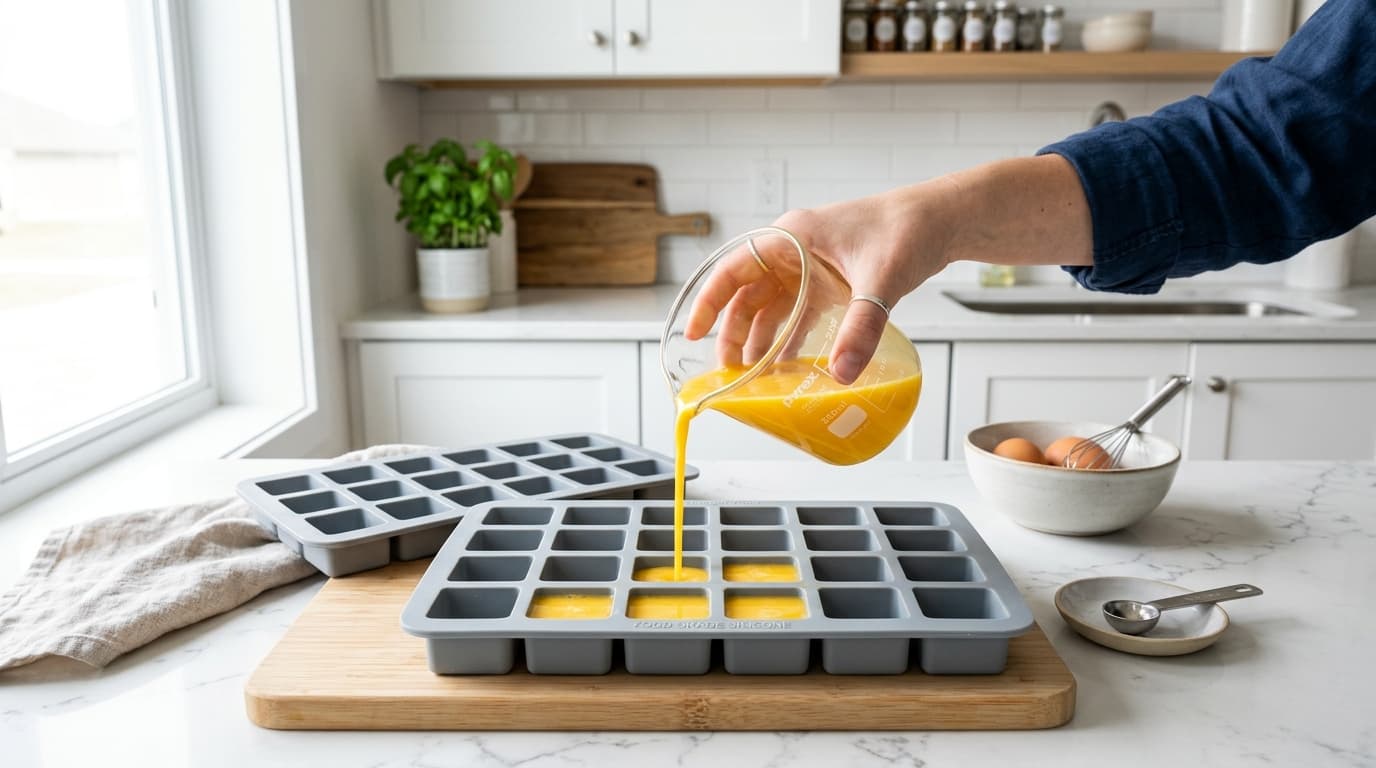
Silicone Cube Portioning: 3 Tbsp Whole / 2 Tbsp White
Silicone ice cube trays are the standard home portioning method. Fill cavities, freeze solid, pop out cubes, and bag with air pressed out for single-recipe convenience.
Flash-Freeze & Bag Protocol
- •Fill each cavity to ~85% capacity to allow expansion without overflow.
- •Freeze solid for 4–6 hours at 0°F (-18°C).
- •Pop cubes out and transfer to a heavy-duty freezer bag.
- •Press out excess air to reduce freezer burn.
Recipe Extraction Math
- •Need 2 eggs for cookies? Pull 2 whole-egg cubes (3 Tbsp each).
- •Need 3 whites for meringue? Pull 3 white cubes (2 Tbsp each).
- •Cubes thaw faster than solid frozen blocks or full pint jars.
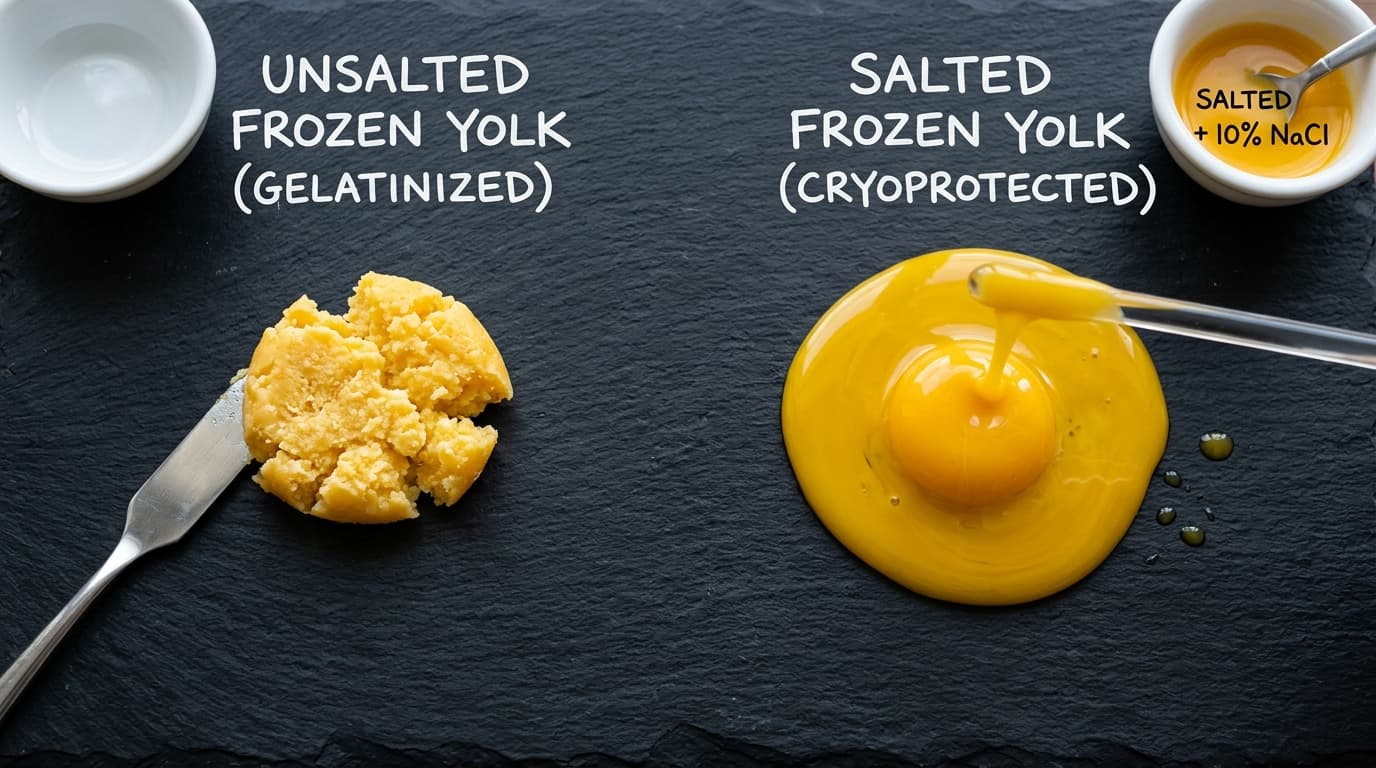
Yolk Gelation: Why Salt or Sugar Is Required
Plain raw yolk frozen without additives turns into a thick, grainy gel upon thawing. Salt or sugar stabilizes yolk texture so it remains fluid and emulsifiable in recipes.
Gelation Mechanism (Kitchen Reference)
- •Ice formation withdraws free water from yolk lipoprotein particles.
- •Without cryoprotectant, yolk proteins aggregate into an insoluble gel.
- •Salt or sugar lowers freezing point and maintains yolk fluidity.
- •Cryoprotected yolks work in mayonnaise, hollandaise, and custards after thawing.
Common Mistakes
- •If you freeze plain yolk by mistake, use it in fully cooked dishes like meatloaf.
- •Always whisk salt or sugar into yolks before placing in the freezer.
- •Label containers “with salt” (savory) or “with sugar” (sweet).

Thawing & Cooking: Fridge Overnight, Use Promptly
Thaw frozen eggs in the refrigerator overnight for best results. Cold running water works for faster thawing. Use promptly in fully cooked dishes — scrambles, baked goods, and casseroles perform like fresh eggs.
Thaw & Use Guidelines (AEB)
- •Refrigerator thaw (35°F–39°F): 12–16 hours for a typical batch.
- •Cold running water: 20–30 minutes in a sealed leakproof bag.
- •Thawed whites beat to better volume after 30 minutes at room temperature.
- •Do not refreeze thawed raw eggs — cook promptly once liquid.
Volume Equivalents
- •3 tablespoons thawed blended egg = 1 Large whole egg.
- •2 tablespoons thawed white = 1 Large egg white.
- •1 tablespoon thawed yolk mixture = 1 Large egg yolk.
Egg Freezing — Portion & Batch Calculator
3 Tbsp whole = 1 Large egg · 12 months at 0°F. Calculate salt or sugar additives, plan silicone tray portions, check accidental in-shell freeze outcomes, and generate freezer labels. Informational journaling tool only.
Select Preparation Format
When cooking your thawed batch, deduct approximately 0.58 tsp of salt from your final scramble, frittata, or bread dough formula.
At a Glance
Never freeze in-shell. Whites freeze plain; whole eggs and yolks need salt (savory) or sugar (sweet) to stay smooth after thawing.
Three freezer formats
American Egg Board · NCHFP · USDA FSIS
| Format | Additive | Portion rule |
|---|---|---|
| Blended whole | ½ tsp salt OR 1½ tbsp sugar / cup | 3 Tbsp = 1 Large |
| Separated whites | None (plain) | 2 Tbsp = 1 white |
| Separated yolks | ⅛ tsp salt OR 1½ tsp sugar / 4 yolks | 1 Tbsp = 1 yolk |
| In-shell raw | Not recommended | Shell cracks (~9% expansion) |
Label tip: Write freeze date, egg count, format, and whether salt or sugar was added — then deduct that additive from your recipe.
Reference Serving
Never freeze in-shell. Freeze blended whole eggs, plain whites, or salted/sugared yolks — up to 12 months at 0°F.
Whole: ½ tsp salt or 1½ tbsp sugar per cup (~5 Large). Whites: no additives. Yolks: ⅛ tsp salt or 1½ tsp sugar per 4 yolks. Thaw in the fridge overnight; use in fully cooked dishes. Label date, count, and whether salt or sugar was added.
Deduct added salt or sugar from your recipe. Do not refreeze thawed raw eggs. Informational only — not dietary advice.
Freezing Formats & Additives (AEB & NCHFP)
| Nutrient | Format | Additive | Max storage (0°F) | Thaw method | Typical uses |
|---|---|---|---|---|---|
| Blended whole eggs | ½ tsp salt OR 1½ tbsp sugar per cup (≈5 Large) | 12 months | Refrigerator overnight | Scrambles, frittatas, pancakes, baking | |
| Separated whites | None — freeze plain | 12 months | Refrigerator overnight | Meringues, angel food, macarons | |
| Yolks (savory) | ⅛ tsp salt per 4 yolks | 12 months | Refrigerator overnight | Mayonnaise, hollandaise, savory doughs | |
| Yolks (sweet) | 1½ tsp sugar or corn syrup per 4 yolks | 12 months | Refrigerator overnight | Custards, pastry cream, brioche | |
| Raw in-shell | Not recommended — shell cracks from expansion | — | — | Remove from shell before freezing | |
| Hard-boiled | Not recommended — whites turn tough & watery | Poor quality | Refrigerator | Cooked yolks only for garnishes |
Source: American Egg Board & NCHFP. Peak quality up to 12 months at 0°F (-18°C). Do not refreeze thawed raw eggs.
Freezer Batch Additive Ratios
| Nutrient | Batch size | Liquid weight | Volume | Salt (savory) | Sugar (sweet) |
|---|---|---|---|---|---|
| 2 Large whole | 100g | 6.5 Tbsp | ¼ tsp | 1.8 tsp | |
| 4 Large whole | 200g | 13 Tbsp | ½ tsp | 3.6 tsp (1.2 Tbsp) | |
| 6 Large whole | 300g | 1.25 cups | ¾ tsp | 1.8 Tbsp | |
| 12 whole (dozen) | 600g | 2.5 cups | 1½ tsp | 3 Tbsp | |
| 4 separated yolks | 68g | 4.4 Tbsp | ⅛ tsp | 1½ tsp | |
| 12 separated yolks | 204g | 13.3 Tbsp | ½ tsp | 4½ tsp (1.5 Tbsp) |
Large egg ≈ 50g liquid (33g white / 17g yolk). 1 cup whole eggs ≈ 5 Large (244g). Deduct added salt or sugar from final recipes.
Portioning & Packaging Reference
| Nutrient | Container | Portion size | Headspace / prep | Best for |
|---|---|---|---|---|
| Silicone ice cube tray | 3 Tbsp whole OR 2 Tbsp white per cavity | Fill to ~85%; freeze 4–6 h, then bag | Single-recipe portions | |
| Freezer bag (flat) | Any batch volume | Press out air; freeze flat on sheet | Space-saving stacks | |
| Wide-mouth mason jar | Large batches | ½-inch (13 mm) headspace minimum | Batch baking prep | |
| Vacuum-sealed bag | Pre-frozen solid cubes | Vacuum after cubes are hard-frozen | Long-term 12-month storage |
Liquid expands ~9% when frozen. Leave ½-inch headspace in rigid jars. Flash-freeze in silicone trays, then bag for easy single-egg portions.
Thaw Methods & Timing
| Nutrient | Method | Environment | Typical duration | Notes |
|---|---|---|---|---|
| Refrigerator (recommended) | 35°F–39°F (2°C–4°C) | 12–16 hours overnight | Best for planning ahead; keeps eggs cold throughout | |
| Cold running water | Cold tap water (<70°F / 21°C) | 20–30 minutes in sealed bag | Use immediately once fully liquid | |
| Microwave (low power) | 30% power, stir between bursts | 2–3 minutes for small batches | Cook immediately after thawing | |
| Room-temperature counter | 68°F–75°F (20°C–24°C) | Not recommended | Outer layer warms while center stays frozen — use fridge or cold water instead |
Thaw in the refrigerator whenever possible. Use thawed eggs promptly in fully cooked dishes. Do not refreeze thawed raw eggs.
Can You Freeze Eggs? (Direct Answer)
Yes — out of the shell, for up to 12 months at 0°F (-18°C). The American Egg Board and USDA FSIS both state that raw eggs should never be frozen in their shells. Egg contents are roughly 75% water; when water freezes it expands about 9%, which cracks the rigid calcium carbonate shell.
The three workable formats: blended whole eggs (with salt or sugar to keep yolks smooth), plain separated whites (no additives needed), and separated yolks (with salt for savory dishes or sugar for baking). Portion into silicone trays or labeled containers, freeze at 0°F or colder, and thaw in the refrigerator before use.
Three Freezing Formats: Whole, Whites & Yolks
Whole eggs: Crack into a bowl and whisk gently with a fork until yolks and whites are combined — do not whip in air. Per NCHFP guidance, add ½ teaspoon salt (savory) or 1½ tablespoons sugar or corn syrup (sweet) per 1 cup of blended eggs (~5 Large). Pour into containers with ½-inch headspace or portion 3 tablespoons per ice-cube cavity (= 1 Large egg).
Egg whites: Separate carefully so no yolk contaminates the white. Pour plain whites into trays or containers — zero salt or sugar required. Each standard cavity holds about 2 tablespoons (33g), equal to one Large white. Once solid (4–6 hours), transfer cubes to a freezer bag.
Egg yolks: Yolks gel when frozen plain, turning thick and grainy upon thawing. Beat in ⅛ teaspoon salt per 4 yolks (savory) or 1½ teaspoons sugar or corn syrup per 4 yolks (sweet), per the American Egg Board. Label whether salt or sugar was added. 1 tablespoon thawed yolk mixture ≈ 1 Large yolk.
Packaging, Accidental Freezing & Thawing
Packaging: Flash-freeze in silicone trays for single-egg portions, then bag with air pressed out to limit freezer burn. Rigid glass jars need ½-inch headspace for ice expansion. Label every container with freeze date, egg count, format (whole/white/yolk), and whether salt or sugar was added.
Accidentally frozen in the fridge: If the shell cracked, discard the egg. If the shell stayed completely intact, keep frozen until needed, thaw in the refrigerator, and use in a fully cooked dish — the yolk will be thicker than usual. See our egg storage guide for refrigerator placement tips.
Thawing: Place frozen eggs in the refrigerator overnight (12–16 hours). For faster thawing, submerge a sealed bag in cold running water for 20–30 minutes. Use thawed eggs promptly in fully cooked recipes (scrambles, baked goods, casseroles). Do not refreeze thawed raw eggs.
Volume Equivalents & Recipe Adjustments
When substituting thawed frozen eggs in recipes, use these volume equivalents from NCHFP and AEB:
• 3 tablespoons thawed blended whole egg = 1 Large shell egg (≈50g).
• 2 tablespoons thawed white = 1 Large egg white (≈33g).
• 1 tablespoon thawed yolk mixture = 1 Large egg yolk (≈17g).
Deduct added salt or sugar: If you froze with salt, reduce recipe salt by about ⅛ tsp per 2 eggs. If you froze with sugar, reduce recipe sugar by about 1–1½ tsp per egg. Thawed eggs work well in scrambles, omelets, frittatas, quick breads, cookies, and yeast doughs — but not for fried sunny-side-up or poached whole eggs because whites and yolks were blended before freezing.
Common Misconceptions
Myth: You can freeze raw eggs in their shells if you freeze them slowly.
Fact: Water always expands ~9% when it freezes, regardless of speed. The rigid shell cracks, exposing contents to air and freezer odors. Always remove eggs from shells before freezing.
Myth: Hard-boiled eggs freeze well for weekly meal prep.
Fact: Cooked whites become tough, rubbery, and watery when frozen. Only cooked yolks freeze acceptably for crumbled garnishes. Hard-boiled whole eggs are not recommended for freezing.
Myth: Egg whites need salt or sugar before freezing, just like yolks.
Fact: Whites are ~88% water with virtually no fat. They freeze cleanly with zero additives and recover full foaming volume after refrigerator thawing.
Myth: It is fine to thaw frozen eggs on the kitchen counter for a few hours.
Fact: Counter thawing warms the outer layer while the center stays frozen. Refrigerator thawing (overnight) or cold running water (20–30 minutes) keeps eggs cold and ready for prompt cooking.
Myth: Frozen eggs lose most of their protein and nutrients after a few months.
Fact: Freezing preserves proteins, vitamins, and minerals in stasis. Quality and foaming power remain strong for up to 12 months at 0°F (-18°C), with gradual decline after that.
Myth: You can thaw and refreeze raw eggs if you have not cooked them yet.
Fact: Do not refreeze thawed raw eggs. Repeated freeze-thaw cycles break down texture and moisture. Once thawed, cook promptly or discard.
Practical Notes for Tracking
- •Flash-freeze in silicone trays: 3 Tbsp per cavity for whole eggs, 2 Tbsp for whites; bag cubes once solid.
- •Label every container: freeze date, format (whole/white/yolk), egg count, and salt or sugar added.
- •Deduct cryoprotectant salt or sugar from your recipe totals when cooking with thawed eggs.
- •Leave ½-inch headspace in glass jars to accommodate ice expansion.
- •Thaw in the refrigerator overnight; use promptly in fully cooked dishes.
Informational only — for personal nutrition awareness and journaling. Not personalized dietary advice. Disclaimer
Frequently Asked Questions
Scientific References & Data Sources
Nutrition values on this page are derived from the peer-reviewed sources below. This page is for informational food logging and personal awareness only. See our disclaimer.
Federal guidance on shell egg storage, accidental in-refrigerator freezing, and why raw eggs are not frozen in-shell.
Home freezing steps for separated whites, cryoprotected yolks, and blended whole eggs; thaw and use notes.
University of Georgia extension ratios for salt or sugar in whole eggs and yolks, ice-tray portioning, and headspace.
Baseline nutrient data for raw whole egg per 100g (143 kcal, 12.6g protein, 9.51g lipid).
Our data sourcing, verification, and fact-checking methodology.