Egg White Types: Formats, Weights & Conversions
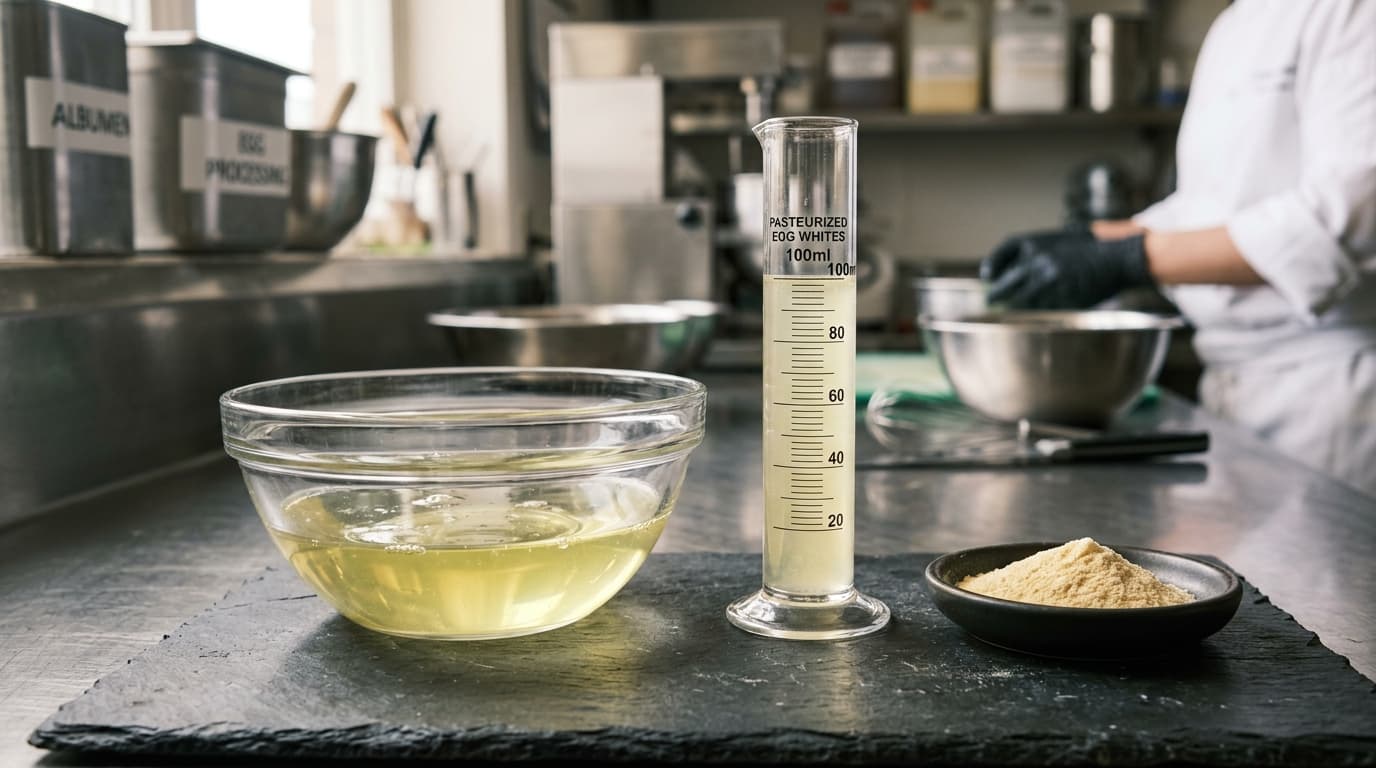
1 Large white = 33g · 17 kcal · 3.6g protein · 0g fat
11.5–12.5% solids · pasteurized · freezes plain
1 part powder + 7 parts water ≈ fresh white
4.1g powder + 28.9g water ≈ 1 Large white (33g)
Fresh Shell White — 33g Pure Protein Baseline
The direct nutritional baseline for kitchen cooking and macro tracking. Represents 66% to 67% of edible liquid egg weight, delivering pure complete protein with a PDCAAS score of 1.00.
Biochemical Makeup (FDC 172183)
- •88.0% water, 10.5% globular protein, 0.7% carbohydrate, 0.05% trace lipids.
- •Thick albumen structured by viscous ovomucin; thin albumen is watery outer layer.
- •Initial unheated pH is 7.6; rises to ~9.2 within days as dissolved CO2 escapes.
- •Thermal coagulation begins at 61°C (ovotransferrin) and sets firm at 84.5°C (ovalbumin).
Kitchen & Logging Guidelines
- •Log white-only entries under FDC 172183; whole eggs at FDC 171287.
- •Separate while cold from fridge when yolk membrane is firmest and least prone to rupture.
- •Allow separated whites to warm to room temperature (68–72°F) before whipping for max volume.
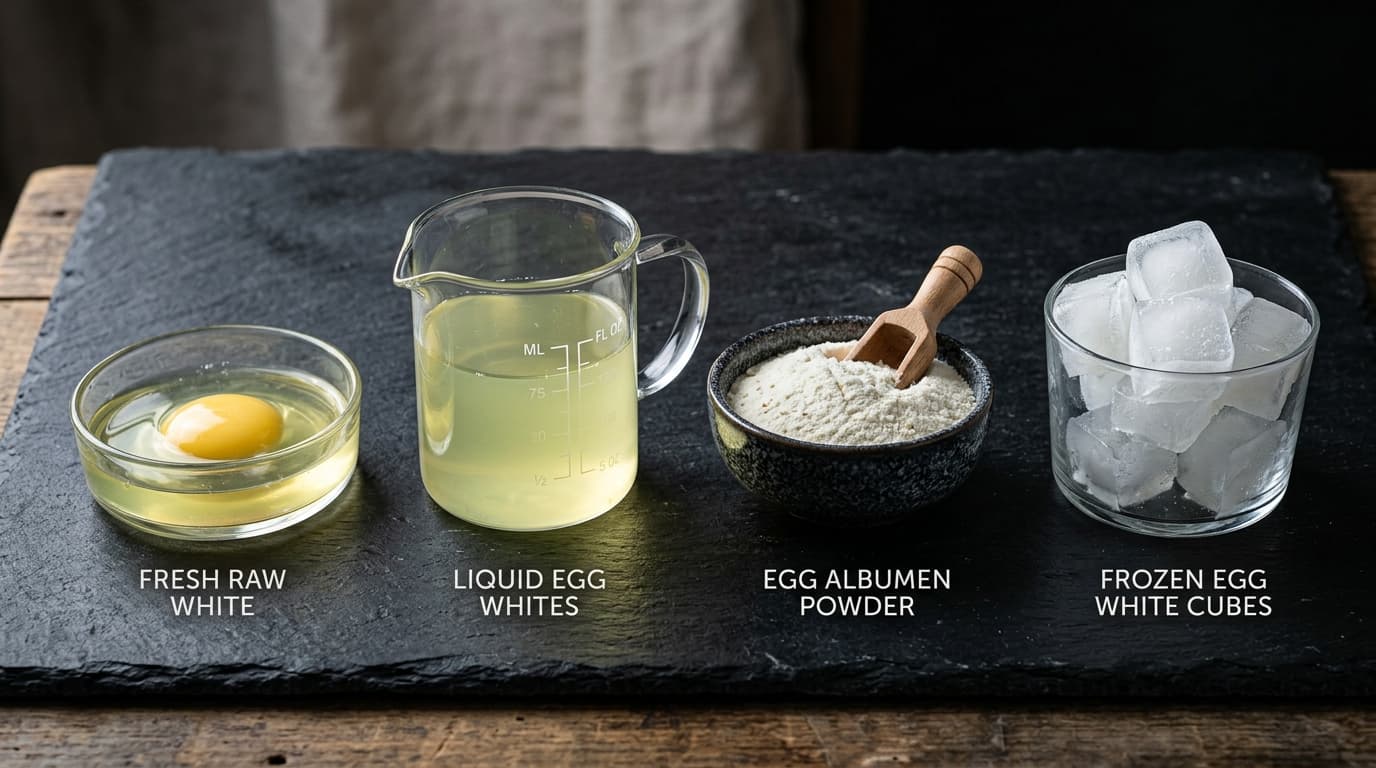
The Four Commercial Formats (AEB & USDA Standards)
Industrial egg breaking facilities separate whites automatically under continuous FSIS inspection. Formats include refrigerated pasteurized liquid, blast-frozen plain whites, and spray-dried powders.
Regulatory & Physical Benchmarks
- •Liquid whites pasteurized at min. 134°F (56.7°C) for 3.5 min without pre-coagulation.
- •1 lb of liquid egg white equals exactly 13.8 standard Large shell egg whites.
- •1 lb of dried albumen powder replaces 115 to 120 Large shell egg whites.
- •Universal reconstitution formula: 1 part powder + 7 parts water by weight = 8 parts liquid.
Kitchen & Logging Notes
- •Refrigerated liquid whites hold 30–45 days chilled; freeze remaining cartons up to 12 months.
- •Pasteurized carton whites follow FSIS handling standards — refrigerate and use by carton date.
- •Store spray-dried powder sealed away from humidity for long ambient shelf life.
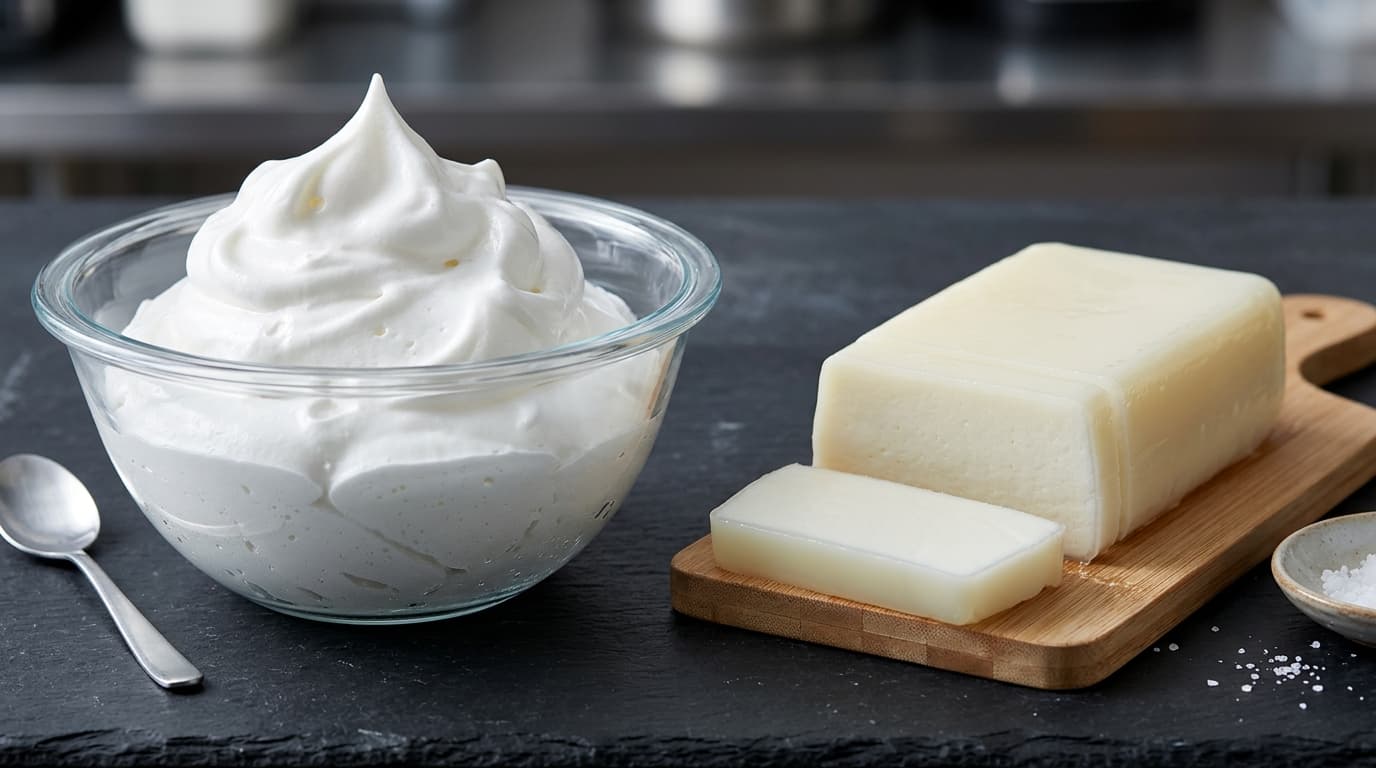
High-Whip vs. High-Gel Functional Albumen
Dried egg white is engineered into specialized grades: High-Whip utilizes FDA-approved surfactants for sky-high meringue volume, while High-Gel utilizes hot-room dry-heat pasteurization for rigid binding.
Functional Engineering Mechanisms
- •High-Whip: Sodium lauryl sulfate (<0.1%) or triethyl citrate lowers surface tension for fast aeration.
- •High-Gel: Dry-heat incubation uncoils protein chains, exposing reactive sulfhydryl (-SH) groups.
- •Heat-set high-gel albumen forms an elastic, water-retaining covalent disulfide network.
- •Essential binder in surimi (imitation crabmeat), frankfurters, vegetarian meats, and ramen dough.
Application Selection Rules
- •Select High-Whip for angel food cakes, macarons, nougat, marshmallows, and fluffy toppings.
- •Select High-Gel for seafood binding, structured sausage casings, and gluten-free pasta elasticity.
- •Standard general-purpose powder provides moderate aeration and moderate binding.
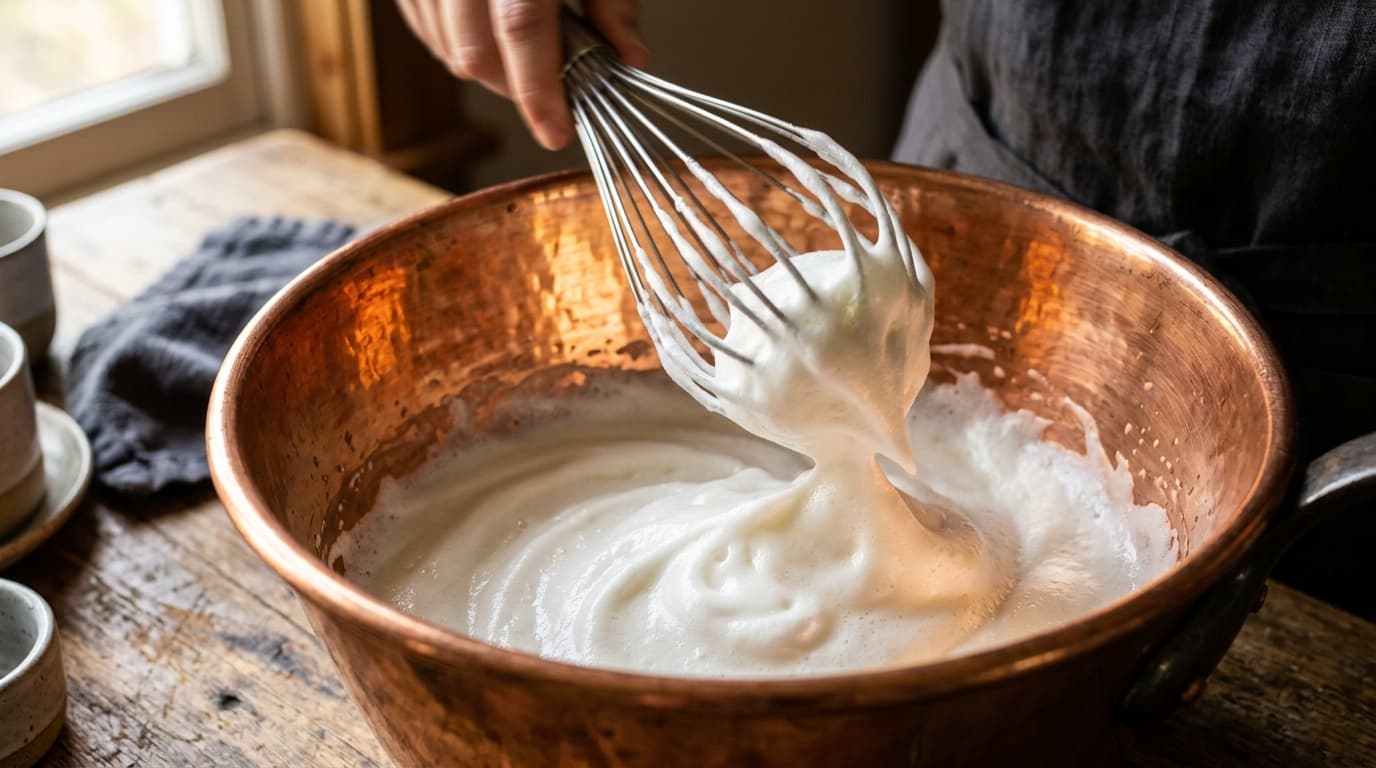
Whipping Physics, Copper Bowls & Acid Stabilization
Whisking forces coiled globular proteins to unfold and align at the air-water boundary. Acid buffers (cream of tartar) neutralize negative charges; copper ions bind ovotransferrin to prevent curdling.
Biophysical Denaturation Stages
- •Hydrophobic amino acids orient into air bubbles; hydrophilic chains anchor in surrounding water.
- •Alkaline pH (~9.2) causes electrostatic repulsion, promoting bubble collapse and syneresis.
- •Cream of tartar (1/8 tsp per 2 whites) lowers pH to 6.5, optimizing elastic protein cross-links.
- •Unlined copper bowls release trace Cu2+ ions that bind ovotransferrin, resisting over-whipping.
Technique & Rescue Guidance
- •Always whisk in glass, copper, or stainless steel; avoid porous plastic bowls that retain fat.
- •Add sugar gradually only AFTER soft peaks form to prevent inhibiting protein unfolding.
- •If over-whipped into grainy clumps, gently fold in one fresh unwhipped white to restore elasticity.
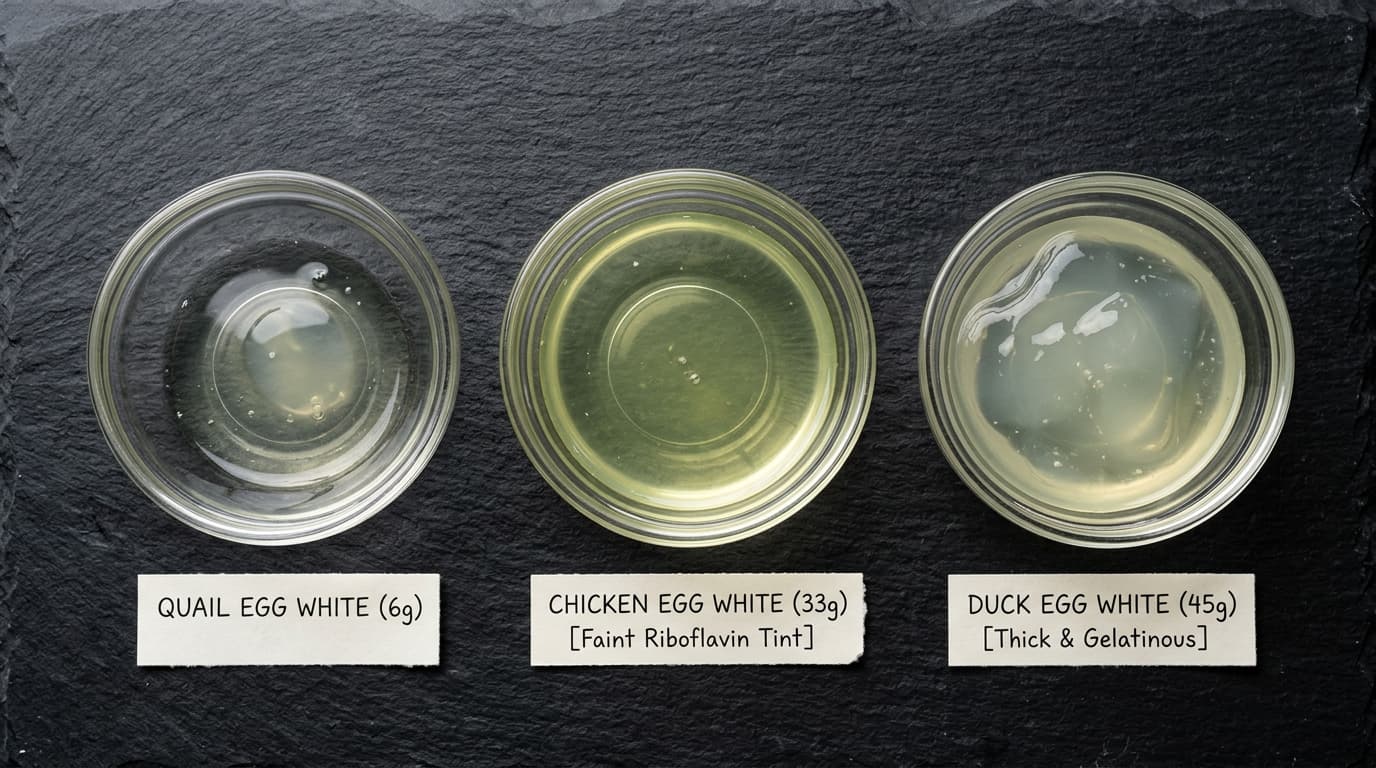
Avian Species Albumen: Chicken vs. Duck vs. Quail
Waterfowl and game bird albumens differ fundamentally in dry matter, protein density, and ovomucin viscosity. Duck whites provide unmatched steam-holding lift in gluten-free baking and chiffon cakes.
Interspecies Comparative Physics
- •Duck egg white contains 11.8% protein and lower free water, creating a denser, heavier initial whip.
- •Duck albumen forms exceptionally tough cell walls that resist collapsing under oven heat.
- •Chicken egg white is the universal benchmark, providing highest volume overrun and lightest crumb.
- •Quail white is a small volume — log by grams when tracking macros.
Baking & Substitution Advice
- •Substitute by weight, not shell count: 3 Large chicken whites (99g) ≈ 2 duck whites (90g).
- •Duck whites excel in heavy-structured batters like panettone, brioche, and artisan sponge cakes.
- •For delicate, tender meringues or angel food cakes, chicken egg whites remain superior.
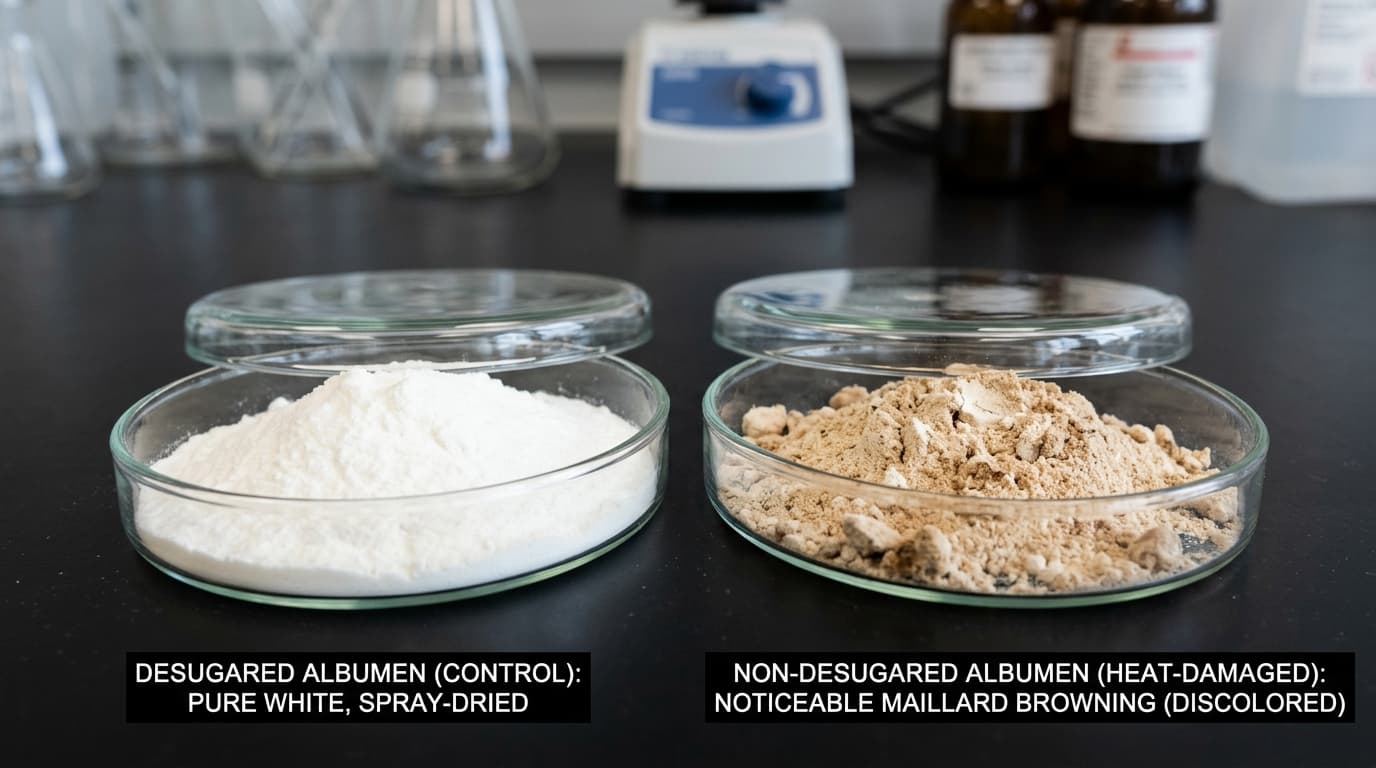
The Desugaring Process: Glucose-Free Storage Stability
Fresh albumen contains ~0.4% free glucose. Unless removed before spray-drying, glucose reacts with protein lysine groups via the Maillard reaction, turning the powder dark brown and completely insoluble.
Maillard Reaction & Industrial Fermentation
- •Non-enzymatic browning: Free glucose aldehyde groups react with protein amino groups during storage.
- •Result of untreated drying: Severe insolubility, loss of foaming lift, and offensive stale odor.
- •Yeast fermentation: Saccharomyces cerevisiae consumes glucose under controlled temperature and pH.
- •Enzyme fermentation: Glucose oxidase + catalase converts glucose to inert gluconic acid and water.
Quality & Storage Insights
- •All commercial retail albumen powders are desugared, guaranteeing pristine white appearance.
- •Keep dried egg white powder tightly sealed; moisture absorption reactivates protein degradation.
- •Desugared powder stores safely at ambient room temperature (65–75°F) for up to 36 months.
Egg White Formats — Logging Calculator
1 Large white = 33g, 17 kcal. Reconstitute dried albumen, scale meringue batches, compare commercial grades, and check yolk-fat contamination. Informational journaling tool only.
Input Conversion Mode
AEB Standard Rule:
1 part dried albumen + 7 parts water (wt) = 8 parts liquid egg white at 12.0% solids.
At a Glance
~66% of whole-egg liquid (50g Large). Log white-only entries at FDC 172183; whole egg at FDC 171287.
Commercial white formats
USDA FSIS 9 CFR Part 590 · AEB specifications
| Format | Spec | Logging note |
|---|---|---|
| Fresh shell white | 33g / Large | 17 kcal, 3.6g protein |
| Liquid (pasteurized) | 11.5–12.5% solids | Weigh in grams |
| Frozen plain white | No additives | Thaws like fresh |
| Spray-dried powder | ≥92% solids | 1 part + 7 parts water |
Powder rule: 4.1g dried albumen + 28.9g water ≈ 1 Large white. Unlike yolks, whites freeze plain with no cryoprotectant.
Reference Serving
Log fresh white as 33g (17 kcal). Powder: 4.1g + 28.9g water ≈ 1 Large white.
14 Large shell whites ≈ 1 lb (454g) commercial liquid white. ~115 Large whites ≈ 1 lb (454g) spray-dried albumen powder.
Pasteurized carton whites may whip slightly slower than fresh shell whites for tall meringues. Informational only — not dietary advice.
Commercial Egg White Formats (AEB & USDA FSIS)
| Nutrient | Format | Min. solids | Key process | Typical use |
|---|---|---|---|---|
| Fresh separated shell white | 11.5–12.5% | None (raw) | Table cooking, meringues | |
| Refrigerated liquid whites | 11.5–12.5% | Pasteurized (134°F / 56.7°C) | Cartons, foodservice | |
| Frozen plain egg white | 11.5–12.5% | Blast-frozen, no additives | Bulk bakery freezing | |
| Standard spray-dried albumen | 92.0% min. | Desugared before drying | Baking mixes, coatings | |
| High-whip dried white | 92.0% min. | Whipping aid (<0.1% SLS) | Angel food, meringues, macarons | |
| High-gel dried white | 92.0% min. | Hot-room dry heat (55–60°C) | Surimi, meat binders, noodles |
9 CFR § 590: liquid whites must contain 11.5–12.5% total solids. Dried powders are desugared before drying to prevent browning during storage.
Shell White → Commercial Conversion (AEB)
| Nutrient | Shell whites | Liquid (g) | Liquid volume | Powder (g) | Water (g) |
|---|---|---|---|---|---|
| 1 Large | 33g | 2.2 tbsp | 4.1g | 28.9g | |
| 6 | 198g | 0.8 cup | 24.8g | 173g | |
| 12 (dozen) | 396g | 1.6 cups | 49.5g | 347g | |
| 14 (≈1 lb liquid) | 454g | 1.9 cups | 56.8g | 397g |
1 part dried albumen + 7 parts water by weight = liquid white at ~12% solids. 4.1g powder + 28.9g water ≈ 1 Large white (33g).
Major Albumen Proteins (Kitchen Reference)
| Nutrient | Protein | % of white | Coagulation | Role in cooking |
|---|---|---|---|---|
| Ovalbumin | ~54% | ~84.5°C (184°F) | Main heat-set gel in baking | |
| Ovotransferrin | ~12% | ~61°C (142°F) | Denatures first in gentle custards | |
| Ovomucoid | ~11% | Heat-stable | Thick gel former; degrades as egg ages | |
| Ovomucin | ~3.5% | Fibrous gel | Thick albumen structure in fresh eggs | |
| Lysozyme | ~3.4% | ~75°C (167°F) | Enzyme; contributes to foam stability |
Approximate fractions from egg science references. Coagulation temperatures describe heat-set behavior in cooking — not medical properties.
Species White Weights for Logging
| Nutrient | Species | White mass | % of edible | Protein % | Logging note |
|---|---|---|---|---|---|
| Chicken (Large) | 33g | 66% | 10.5% | Universal baseline | |
| Duck | ~45g | 60% | 11.8% | Denser; weigh for swaps | |
| Quail | ~6g | 65% | 10.6% | Small volume; log by grams | |
| Goose | ~90g | 62% | 11.5% | ≈2.7 Large chicken whites |
Substitute by edible white grams, not shell count. Values scaled from USDA FDC whole-egg entries.
The Direct Answer: One Large Egg White = 33g
In a standard Large egg (50g edible whole), the white contributes 33 grams — about two-thirds of edible mass. Log 17 kcal, 3.6g protein, 0g fat, 0mg cholesterol per white (FDC 172183).
Albumen is ~88% water and ~10.5% protein. For white-only diary entries use FDC 172183; whole eggs use FDC 171287.
Commercial Formats Under USDA FSIS
Refrigerated liquid whites — pasteurized, 11.5–12.5% solids, 30–45 days chilled. Common in cartons and foodservice.
Frozen plain whites — unlike yolks, whites freeze without additives and recover foaming ability after refrigerator thaw.
Spray-dried albumen — ≥92% solids. Reconstitute 1 part powder + 7 parts water by weight. One pound powder replaces ~115 Large shell whites.
Functional grades: High-whip (surfactant for meringues) and high-gel (hot-room treated for binding applications).
Desugaring & High-Whip vs High-Gel
Fresh albumen contains ~0.4% free glucose. If dried with glucose present, storage heat can cause Maillard browning — powder turns brown and loses solubility. Commercial dried whites are desugared first (yeast fermentation or glucose oxidase) per FDA 21 CFR Part 160.
High-whip powder includes FDA-approved whipping aids (e.g. sodium lauryl sulfate <0.1%) for maximum foam volume in angel food cakes and meringues.
High-gel powder undergoes controlled dry-heat treatment (55–60°C for 7–14 days) to enhance binding in surimi, restructured meats, and noodle dough.
Freezing, Whipping & Fat Contamination
Whites contain virtually no fat, so they freeze plain without the gelation problem that affects yolks. Thaw in the refrigerator before whipping.
Whisking unfolds albumen proteins at the air-water boundary. Cream of tartar (~1/8 tsp per 2 whites) lowers pH to ~6.5 for stabler foam. Copper bowls can help by binding ovotransferrin.
Even ~0.03% yolk fat can sharply reduce foam volume — lipid molecules displace proteins at the bubble surface. Separate carefully and use clean, degreased bowls for meringues.
Common Misconceptions
Myth: Cloudy egg whites mean the egg has spoiled.
Fact: Cloudiness in very fresh whites comes from dissolved CO₂. As eggs age, CO₂ escapes and whites become clearer.
Myth: Salt makes egg whites whip faster and stiffer.
Fact: Salt can weaken foam structure. Add acid (cream of tartar or lemon juice) to whites; add salt to the batter or flour instead.
Myth: Carton liquid whites whip exactly like fresh shell whites.
Fact: Pasteurization partially denatures some proteins, so carton whites may take longer to reach stiff peaks. Fresh shell or high-whip dried powder often performs best for tall meringues.
Myth: All egg protein is in the white.
Fact: A Large white holds ~57% of whole-egg protein (3.6g); the yolk holds ~43% (2.7g). Yolk is denser in protein per gram, but white has more total because of greater volume.
Myth: Frozen raw whites are ruined after thawing.
Fact: Unlike yolks, whites freeze without cryoprotectants and typically whip and cook like fresh after gentle refrigerator thaw.
Myth: Raw egg whites are always the best choice for protein logging.
Fact: Laboratory digestibility studies report higher protein availability from cooked whites than raw. Log according to how you actually prepare them — raw, poached, or baked.
Practical Notes for Tracking
- •Default diary entry: 1 Large white = 33g (FDC 172183). Weigh for precision in baking.
- •Reconstitute powder: 4.1g powder + 28.9g water ≈ 1 white; rest 10 minutes before whipping.
- •Degrease bowls with vinegar or lemon juice before separating whites.
- •Separate cold; whip at room temperature for best volume.
- •Freeze leftover whites plain in ice cube trays (~33g per cube).
Informational only — for personal nutrition awareness and journaling. Not personalized dietary advice. Disclaimer
Frequently Asked Questions
Scientific References & Data Sources
Nutrition values on this page are derived from the peer-reviewed sources below. This page is for informational food logging and personal awareness only. See our disclaimer.
Commercial standards for liquid, frozen, spray-dried, high-whip, and high-gel egg white products, including reconstitution ratios.
Federal egg product rules: minimum solids for liquid whites, pasteurization, and inspection standards.
Standards of identity for liquid, frozen, and dried egg whites, including desugaring before drying.
Large white baseline scaled from 100g: 33g edible = 17 kcal, 3.6g protein, 0.05g fat, 0mg cholesterol.
Our data sourcing, verification, and fact-checking methodology.