Egg Nutrition Facts Labels & Carton Decoding
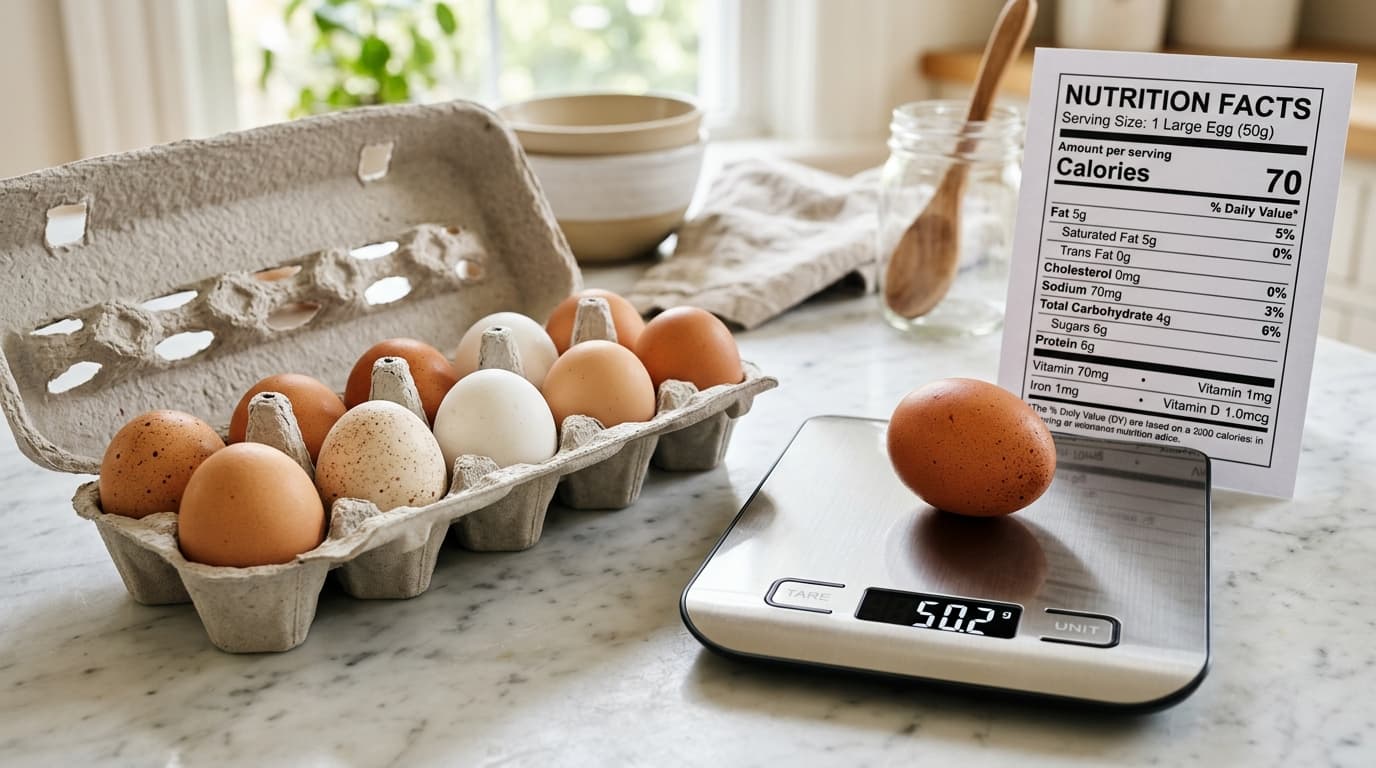
Egg Nutrition Facts Labels: Panel Decoding
Visual reference for FDA Nutrition Facts panels — standard and dual-column servings, size classes, white vs yolk splits, and liquid carton labels. For food diary logging. Informational only.
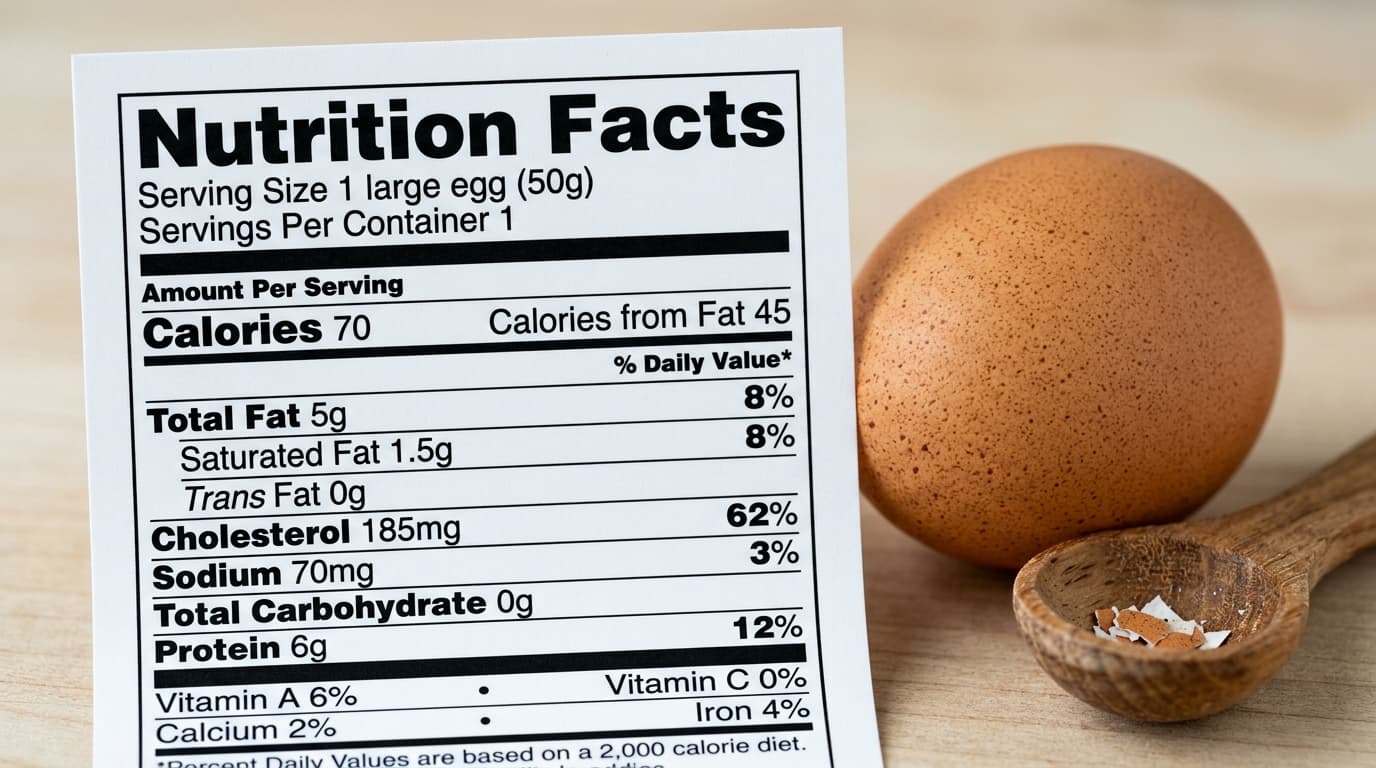
Standard 1 Large Egg Label (50g FDA RACC)
The reference Nutrition Facts panel on U.S. egg cartons. Serving size = **1 Large egg (50g)** under 21 CFR 101.12. Values are FDA-rounded; USDA FDC lists 72 kcal analytically for the same portion.
Mandatory Panel Lines
- Calories rounded to 70 kcal per 21 CFR 101.9(c)(1) (analytical ~72 kcal).
- 6g protein = 12% DV — meets “Good Source of Protein” threshold (10–19% DV).
- Added Sugars line mandatory since 2016 label update — eggs declare 0g.
- Vitamin D and Potassium are mandatory micronutrients on modern panels.
Food Diary Logging
- Use 70 kcal / 6g protein when logging from a carton label.
- Use 72 kcal / 6.3g protein if your app pulls USDA FDC 171287.
- Choline (150mg / 25% DV) is often shown voluntarily on egg cartons.
- Pick “Large” size in your app unless the carton specifies another class.

Dual-Column 2-Egg Serving (100g)
Permitted under 21 CFR 101.9(b)(12)(i) when eggs are customarily eaten in pairs. Column 1 = 1 egg; Column 2 = 2 eggs — log the column that matches your plate.
Dual-Column Rules
- Both columns use the same nutrient order and % DV footnote.
- 2 eggs = 24% DV protein — qualifies as “Excellent Source of Protein”.
- 2 eggs = 10% DV vitamin D — qualifies as “Good Source of Vitamin D”.
- Sodium stays low at 140mg (6% DV) for two eggs.
Food Diary Logging
- Log 140 kcal / 12g protein when you eat two Large whole eggs.
- Add pan butter or oil separately if eggs are fried.
- Poached or boiled two-egg plates match carton values without added fat.

Jumbo Egg Label (63g)
Jumbo is the largest USDA weight class (30 oz/dozen minimum). Label values scale with edible mass — one Jumbo egg declares ~90 kcal and 8g protein vs 70 kcal / 6g for Large.
Size Scaling
- 26% more edible mass than Large (63g vs 50g).
- In baking, 4 Jumbo eggs ≈ 5 Large eggs by liquid weight.
- All five commercial size classes use the same panel format — only numbers change.
Food Diary Logging
- Select “Jumbo” in your app — logging as Large undercounts ~20 kcal per egg.
- Two Jumbo eggs ≈ 180 kcal, 16g protein on the label.

Egg White Only Label (33g)
Albumen-only panel: ~17 kcal, 3.6g protein, 0g fat, 0mg cholesterol. Log at FDC 172183 when tracking whites separately from yolks.
Partitioning
- ~88% water, ~11% protein (ovalbumin, ovotransferrin, ovomucoid).
- No fat-soluble vitamins (A, D, E, K).
- Most of the whole egg’s natural sodium (~55mg of 70mg) is in the white.
- Qualifies for “Fat-Free” (<0.5g fat) and “Cholesterol-Free” (<2mg) claims.
Food Diary Logging
- 1 whole egg + 2 extra whites ≈ 17.8g protein, ~123 kcal — common scramble ratio.
- Liquid carton whites: 3 tbsp (46g) ≈ 1 large white.
- Whites omit choline, lutein, and vitamin D found in the yolk.
Egg Yolk Only Label (17g)
The yolk holds ~78% of whole-egg calories, all dietary cholesterol, most choline, and all vitamin D. Log at FDC 172184 when tracking yolks only.
Yolk Composition
- Contains ~99% of whole-egg lipids and 100% of cholesterol (185mg).
- Holds vitamin D, lutein, zeaxanthin, and most choline.
- Yolk lecithin emulsifies sauces (mayonnaise, hollandaise).
- Higher protein percentage by weight than white (~16% vs ~11%).
Food Diary Logging
- One yolk = 55 kcal — log separately when making yolk-only custards.
- Discarding yolks removes most calories and fat-soluble vitamins from the entry.
- In baking, yolk fat tenderizes dough; whites alone give more lift.
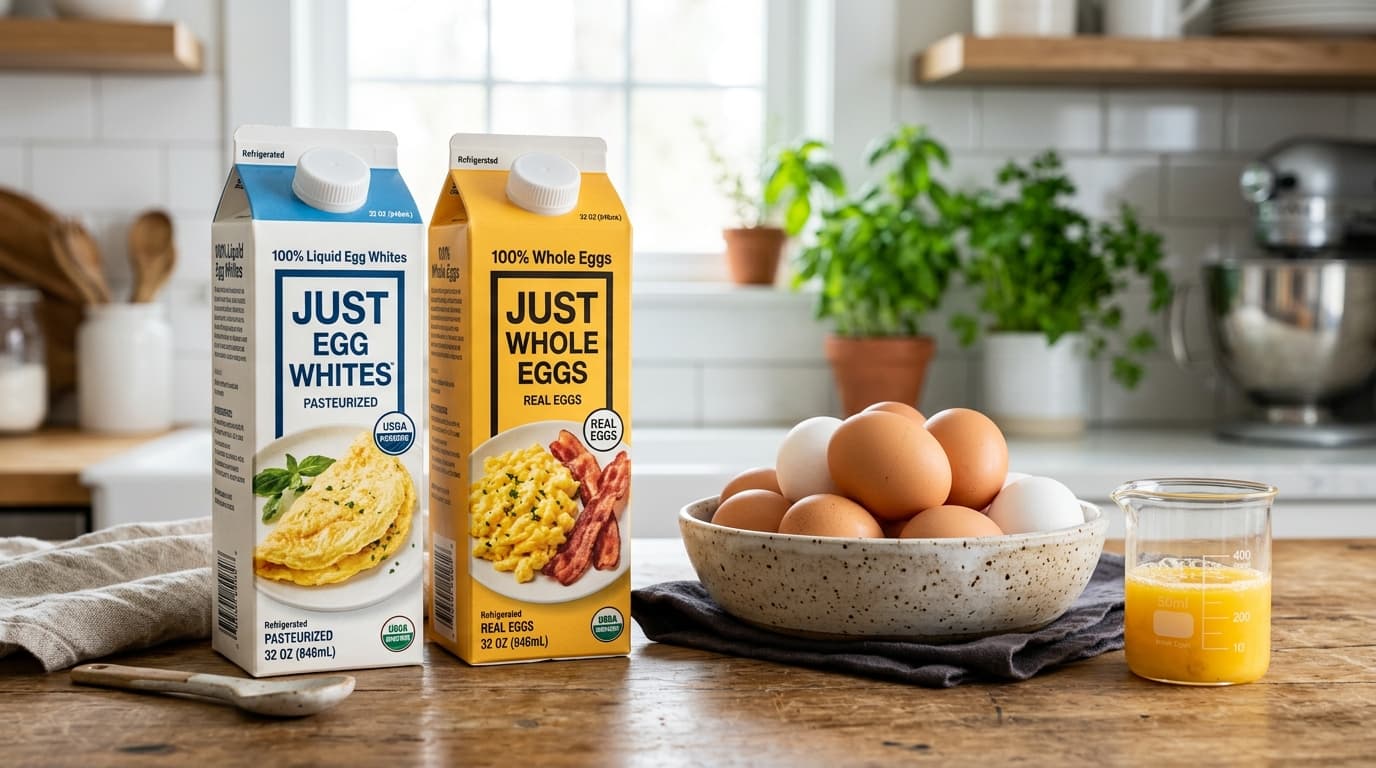
Liquid Whole Egg Carton Label (USDA FSIS)
Pasteurized liquid whole egg cartons (USDA FSIS, 9 CFR 590) declare the same per-serving macros as shell eggs: 3 tbsp (50g) = 70 kcal, 6g protein. Useful when logging from a pour carton instead of counting shells.
Product Standards
- Minimum 24.2% egg solids to label as liquid whole egg.
- Continuous pasteurization under USDA FSIS inspection.
- No artificial colors permitted in whole egg products.
- May include ~0.15% citric acid to reduce gray-green discoloration when held warm.
Food Diary Logging
- 3 tbsp (50g) liquid = 1 Large shell egg for logging.
- Liquid egg white cartons: ~25 kcal, 5g protein per 3 tbsp serving.
- Refrigerate opened cartons; use within 3–5 days.
Egg Nutrition Facts & Label Generator
Build FDA-style Nutrition Facts readouts by size, compare white vs yolk splits, check carton claim thresholds, and log breakfast macros with cooking fat. Informational only — not dietary advice.
Customize Label Parameters
The FDA Reference Amount Customarily Consumed (RACC) for raw whole shell eggs is 50 grams (one Large egg). Note that "Calories from Fat" has been permanently removed, Vitamin D and Potassium are mandatory, and Added Sugars is mandatory at 0g (0% DV).
Nutrition Facts
At a Glance
Under 21 CFR 101.9, retail egg cartons use a Nutrition Facts panel. The RACC for whole shell eggs is 1 Large egg (50g edible) per 21 CFR 101.12.
Typical Large label (FDA rounded): 70 kcal · 5g total fat (6% DV) · 185mg cholesterol (62% DV) · 70mg sodium (3% DV) · 0g carbs · 0g added sugars · 6g protein (12% DV) · Vitamin D 1.0 mcg (6% DV).
Dual-column cartons may show 1 egg and 2 eggs side-by-side (140 kcal, 12g protein for two Large eggs).
Logging tip: Carton labels use FDA rounding (70 kcal); USDA FDC lists 72 kcal analytically — both are valid depending on your app.
Reference Serving
Carton label: 1 Large = 70 kcal, 6g protein. Log 2 eggs as 140 kcal, 12g protein.
FDA RACC is one 50g Large egg. Dual-column panels add a 2-egg (100g) column for typical breakfast portions. Jumbo (63g) labels ~90 kcal; Small (38g) ~50 kcal.
Housing labels (cage-free, organic, pasture-raised) describe production — not different baseline macros. Only omega-3 enriched eggs change polyunsaturated fat on the panel. Informational only.
Nutrition Facts Panel by Egg Size (Per 1 Egg, FDA Rounded)
| Nutrient | Size | Edible (g) | Calories | Fat | Sat fat | Cholesterol | Sodium | Protein | Vit D | Choline |
|---|---|---|---|---|---|---|---|---|---|---|
| Jumbo | 63g | 90 kcal | 6.0g (8% DV) | 2.0g (10% DV) | 235mg (78% DV) | 90mg (4% DV) | 8.0g (16% DV) | 1.3 mcg (6% DV) | 190mg (35% DV) | |
| Extra Large | 56g | 80 kcal | 5.5g (7% DV) | 1.8g (9% DV) | 210mg (70% DV) | 80mg (3% DV) | 7.0g (14% DV) | 1.1 mcg (6% DV) | 170mg (30% DV) | |
| Large (RACC) | 50g | 70 kcal | 5.0g (6% DV) | 1.5g (8% DV) | 185mg (62% DV) | 70mg (3% DV) | 6.0g (12% DV) | 1.0 mcg (6% DV) | 150mg (25% DV) | |
| Medium | 44g | 60 kcal | 4.0g (5% DV) | 1.3g (7% DV) | 165mg (55% DV) | 60mg (3% DV) | 5.5g (11% DV) | 0.9 mcg (4% DV) | 130mg (25% DV) | |
| Small | 38g | 50 kcal | 3.5g (4% DV) | 1.1g (6% DV) | 140mg (47% DV) | 55mg (2% DV) | 4.8g (10% DV) | 0.8 mcg (4% DV) | 115mg (20% DV) |
% DV based on FDA reference intakes: fat 78g, sat fat 20g, cholesterol 300mg, sodium 2,300mg, protein 50g, vitamin D 20 mcg, choline 550mg.
Dual-Column Panel: 1 Large Egg vs 2 Large Eggs
| Nutrient | Nutrient | 1 egg (50g) | % DV | 2 eggs (100g) | % DV | DV baseline |
|---|---|---|---|---|---|---|
| Calories | 70 kcal | — | 140 kcal | — | 2,000 kcal reference | |
| Total fat | 5.0g | 6% | 10.0g | 13% | 78g | |
| Saturated fat | 1.5g | 8% | 3.0g | 15% | 20g | |
| Cholesterol | 185mg | 62% | 370mg | 124% | 300mg | |
| Sodium | 70mg | 3% | 140mg | 6% | 2,300mg | |
| Total carbohydrate | 0g | 0% | 1g | 0% | 275g | |
| Protein | 6.0g | 12% | 12.0g | 24% | 50g | |
| Vitamin D | 1.0 mcg | 6% | 2.0 mcg | 10% | 20 mcg | |
| Choline (voluntary) | 150mg | 25% | 300mg | 55% | 550mg |
Dual-column format permitted under 21 CFR 101.9(b)(12)(i) when foods are customarily eaten in multiples of one RACC.
Whole vs White vs Yolk (1 Large Egg, Label Values)
| Nutrient | Nutrient | Whole (50g) | White (33g) | Yolk (17g) | Logging note |
|---|---|---|---|---|---|
| Calories | 70 kcal | 17 kcal | 55 kcal | ~78% of kcal is in the yolk | |
| Total fat | 5.0g | 0g | 4.5g | Fat is yolk-only | |
| Cholesterol | 185mg | 0mg | 185mg | Cholesterol is yolk-only | |
| Sodium | 70mg | 55mg | 8mg | Most sodium is in albumen | |
| Protein | 6.0g | 3.6g | 2.7g | White contributes more grams; yolk is denser per gram | |
| Vitamin D | 1.0 mcg | 0 mcg | 1.0 mcg | Fat-soluble; yolk only | |
| Choline | 150mg | 0.4mg | 115mg | Most choline is yolk-bound |
Analytical source: FDC 171287 (whole), 172183 (white), 172184 (yolk). Label values are FDA-rounded.
Front-of-Carton Claim Thresholds (21 CFR Part 101)
| Nutrient | Claim | Regulation | Threshold | 1 Large egg | 2 Large eggs |
|---|---|---|---|---|---|
| Good Source of Protein | 21 CFR 101.54(c) | 10–19% DV (5–9.5g) | 6g = 12% DV ✓ | 12g = 24% DV | |
| Excellent Source of Protein | 21 CFR 101.54(b) | ≥20% DV (≥10g) | 6g — not met | 12g = 24% DV ✓ | |
| Excellent Source of Choline | 21 CFR 101.54(b) | ≥20% DV (≥110mg) | 150mg = 27% DV ✓ | 300mg = 55% DV ✓ | |
| Good Source of Vitamin D | 21 CFR 101.54(c) | 10–19% DV | 1.0 mcg = 6% DV | 2.0 mcg = 10% DV ✓ | |
| Low Sodium | 21 CFR 101.61(b) | ≤140mg per RACC | 70mg ✓ | 140mg ✓ | |
| Zero Added Sugars | 21 CFR 101.60(c) | No added sugars | 0g ✓ | 0g ✓ |
Nutrient content claims are optional marketing statements — verify against the back-panel Nutrition Facts serving you log.
Reading the FDA Nutrition Facts Panel
Egg cartons sold in the U.S. follow 21 CFR 101.9. The 2016 label update enlarged calorie type, removed “Calories from Fat,” made Vitamin D and Potassium mandatory, and added Added Sugars (eggs declare 0g).
The % Daily Value (% DV) column shows how one serving compares to FDA reference intakes on a 2,000-calorie reference diet. A common shorthand: 5% DV or less = low; 20% DV or more = high — useful when comparing label lines, not as personal intake guidance.
Serving Size: 1 Egg RACC vs Dual-Column 2 Eggs
RACC for whole shell eggs is 50g — one Large egg (21 CFR 101.12). Cartons list this as the serving size even though many recipes and breakfast plates use two eggs.
When eggs are customarily eaten in multiples, manufacturers may use a dual-column label: Column 1 = 1 egg; Column 2 = 2 eggs. For food diary logging, enter the column that matches what you actually ate.
White vs Yolk on the Label
A Large whole egg (~50g) splits into ~33g white and ~17g yolk. The yolk holds most calories, fat, cholesterol, choline, and vitamin D; the white holds most of the protein grams with near-zero fat.
Log whole egg (FDC 171287), egg white (172183), or egg yolk (172184) separately when tracking separated eggs or liquid carton products.
Carton Claims, Sizes & Cooking Offsets
Front labels (“cage-free,” “organic,” “pasture-raised”) describe hen housing and feed — baseline macros on the Nutrition Facts panel stay ~70 kcal / 6g protein per Large egg unless the product is omega-3 enriched (higher polyunsaturated fat declared on panel).
Size matters for logging: pick Jumbo, Large, or Small in your app to match the carton class. Cooking method matters too: poached/boiled eggs match the carton label; fried eggs need the pan butter or oil logged separately (+~34 kcal per tsp butter).
Common Misconceptions
Myth: Eggs contain hidden carbs or added sugars not shown on the label.
Fact: Whole eggs have under 0.6g total carbohydrate per egg. FDA rounding shows 0g Total Carbohydrate and 0g Added Sugars. No sugars are added to fresh shell eggs.
Myth: The sodium on the label means salt was added to fresh eggs.
Fact: Fresh shell eggs contain naturally occurring sodium (~70mg per Large egg), mostly dissolved in the albumen. No salt is added during grading or packing.
Myth: Discarding the yolk removes only fat — protein stays the same.
Fact: One white delivers ~3.6g protein; the yolk adds ~2.7g. Removing the yolk also removes vitamin D, choline, and most of the egg’s calories.
Myth: Pasture-raised or organic eggs have a different calorie count on the label.
Fact: Housing labels do not change the standard Large baseline (~70 kcal, 6g protein). Yolk color and some micronutrients may vary; declared macros on conventional cartons remain the reference for logging.
Myth: Carton labels and USDA FoodData Central always show the same calories.
Fact: Labels use FDA rounding rules (70 kcal per Large egg). FDC lists analytical values (72 kcal). Both are correct in their context — match your logging app’s data source.
Practical Notes for Tracking
- •Log 1 Large egg as 70 kcal / 6g protein (carton label) or 72 kcal / 6.3g protein (USDA FDC) — stay consistent in your app.
- •Use the dual-column 2-egg values (140 kcal, 12g protein) when that matches your plate.
- •Select egg size (Jumbo, Large, Small) in your app to match the carton class.
- •Log pan butter or oil separately for fried eggs (+~34 kcal per tsp butter).
- •Use FDC 172183 / 172184 when logging whites or yolks only.
Informational only — for personal nutrition awareness and journaling. Not personalized dietary advice. Disclaimer
Frequently Asked Questions
Scientific References & Data Sources
Nutrition values on this page are derived from the peer-reviewed sources below. This page is for informational food logging and personal awareness only. See our disclaimer.
Federal rules for Nutrition Facts format, mandatory nutrients, % Daily Values, and rounding.
RACC table lists “Eggs (all sizes)” at 50g with serving statement “1 large, medium, etc.”
Thresholds for front-of-package claims such as “Good Source” and “Excellent Source” of protein.
Official AEB Nutrition Facts panel templates by egg size (Small through Jumbo), aligned with the FDA 2016 label rule.
Official vertical Nutrition Facts artwork for one Large egg (50g): 70 kcal, 6g protein, 5g fat, 185mg cholesterol.
SR Legacy analytical data per 100g; ~50g edible portion = 72 kcal, 6.3g protein (before FDA label rounding to 70 kcal / 6g).
SR Legacy albumen data; ~33g white per Large egg ≈ 17 kcal, 3.6g protein on labels.
SR Legacy yolk data; ~17g yolk per Large egg ≈ 55 kcal, 2.7g protein, 185mg cholesterol on labels.
Our data sourcing, verification, and fact-checking methodology.